Showing posts with label New Writer. Show all posts

01 March

Writer Voice - Write You, Not Them...


New writers... they're a special breed.

Coming off eons of notebook navel-gazing scribbles and polished pro reading... these new scribes KNOW what's good and what's not, and by gum, they'll write freakishly polished first drafts, or not write at all! If The New Yorker or the New York Times don't hire them on the spot after just their first article flying into the ether, then, at least, their first Pulitzer Prize will arrive by UPS later today. Yes. Right out of the gate. They will be THAT good.

I love new writers. Bright-eyed and bushy-tailed. Full of vim and vinegar. And hopes higher than Everest (with deadly literary crevasses as deep, but don't tell these gleeful souls).

The Newbie Writer Secret Recipe: they've read everything their favorite writer has ever written, and they have that pro scribe's literary voice DOWN COLD. These freshly brewed hacks will explode onto the word crafting scene as Idol Scribe 2.0. They even bought the smoking jacket and cravat their fav writer wears! There's nothing to stop their stratospheric popularity now, boy. One typed out word, and their accolades and riches await.

Did I mention I just WUV newbie writers?

~~~

Author Vignette:

For years, newbie writer, Hunter S. Thompson, typed out passages from F. Scott Fitzgerald's works in an attempt to morph into being Scott. Hunter often said that as Fitz examined, and wrote from inside, the well-heeled world, he, Hunter, committed literary B & E into that same world. And anyone who reads these two writers side by side will wholeheartedly agree. Their writer voices couldn't be farther apart if they tried, even if they shared the same deathly love affair with booze.

~~~

Stories like this wane and waft all over the place, where a fan dives deep into their idol's world, to emulate, to inhale that world. But although mechanics and line style can be well refined in following the greats, more often than not their voice is never found within those well-celebrated pages.

Why, you ask?

Because they are Them, and you are You. And you'll not be each other, ever.

New writers are frequently paralyzed by this need to BE somebody else. This is probably why they began to scribble in those notebooks in their teens.

They think to themselves, "If only I did this, or said things this way, or bought that, or travelled there, or drank here, or schmoozed with whomever my idol sidled up to..."

STOP.

STOP thinking, doing that.

You're wasting time and money you do NOT have for a quest that can never be fulfilled.

Hint: The world does NOT NEED another Them. We already have Them. We NEED YOU.

That one-of-a-kind, irreplaceable YOU.

We need YOUR viewpoint on our human experience. We need your heart, emotions, intellect and drive.

Yes, at first, as the newbie writer you are, your literary You will come with many mechanical warts, but over time and much practice, you will open our eyes and professionally deliver something we could have never received from those already celebrated Them's, not if we hunted for said for a million years. 

Scary Fact: Your word gifts will only last as long as you do, and every moment you're wasting trying to suppress them to be Them is time you're stealing from us — your future reader fans.

HOMEWORK: STOP trying to be someone you're not. Sit down, and start pounding those keys, expecting, nay DEMANDING, your literary warts to show, so you can correct and learn from them, and get ever closer to the stellar You, we're dying to read.

Moral of the Fitzgerald/Thompson Twinning Writer Voice Tale: both ended up married to the bottle, losing their ability to write, and dying a pathetic death well before their time. I guess that's something that's aptly copied over from idol to fan. Yay. (Not.)

15 February

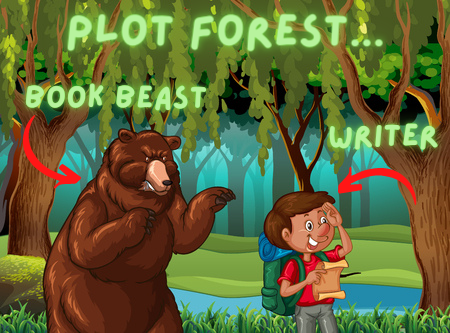
Mapping the Plot Forest to Escape the Book Beast...


Oh, happy day!

I’ve packed my sack. I’ve donned by sturdy boots. And I’m off to wander around my book’s Plot Forest… WHEEE!!!

The warm sunshine on my face.

The soft breeze…

I trek here, snoop there. It’s a wonderland of story ideas I can gather as plot treasure…

I sit down on the lush grass and I examine them all!

Hacking out words of awe, following each avenue, until…

Storm clouds brew.

Sky closes in.

A growing growling emanates from within the plot forest.

A big, old, hairy bruit — the Mighty Book Beast — lumbers up behind me!

I run! I run in circles! I run into dead ends! Round and round and back and forth, the Book Beast gaining on me with every step!

Fear, abject plot forest fear, topples me, and I roll, roll, roll down the craggy hill. Beaten and bruised, I gather my wits and my limbs, and I break free of that nebulous, nefarious forest, never to return again.

~~~

Yup. *insert look of disdain at you happy-go-UNlucky hapless plot forest trekkers*

~~~

Who in their hair-brained mind enters a literal or literary forest without a map? Who? Who, I say? Those whose desiccated bones are found years later in the mire and muck, their carcass splayed out on the dry, dusty pages the Unfinished Book Beast gnawed on that serene sunny afternoon when you were romping around your plot forest without a care in the world like some lobotomized Walmart greeter.

~~~

  • IF you’re new to book writing.
  • IF you haven’t yet finished one book, much less many.
  • IF you haven’t a clue about what it takes to create a complete, well-formulated story plot, with highs and lows — action tension and narrative pause beats.

Then what in the fricken fairyland are you doing gallivanting in a world in which you haven’t a clue to safely traverse?

Yes. Expert writers, who know their genre plot line backwards and forwards, can begin and end their tales without much prior mapping, but that skill level can take years of experience with umpteen finished books under their arms.

If you’re new to book writing, here’s a Fun Fact: YOU AIN’T THEM.

Yeah, yeah, slay me, your one and only realistic Messenger, like I haven’t been slayed by other newbies before…

As an example, I’ll give ya a short Don’t Do This tale…

Recently, I started a brand-new series, entering into the murder mystery genre world. It's a venture customized for online readers who want light and airy, Pringles potato chip addicted tales of mayhem fun.

I dove into this project before taking a break after finishing a very complex WWII literary epic-length work. I was mentally exhausted. That state hampered my reasoning, and in taking on this series, I began to write in a desperation mode that is not normally me, by beginning the four-book tale with only a bare-bones plot line.

That slip-shod preparation has made finishing Book One a far more tedious, far more edit unfriendly exercise, taking me many months to finish when it should have only taken me one.

I know better.

I’ve always prepared at least 80% of my scenes before I've plunked even one laptop key.

But in my desperation to finish this new project, I threw my brain out the window, and with it any semblance of order and expediency in finishing the first book.

Yep. Even an old dog needs to RELEARN old tricks. Seriously. If you look up the word, pathetic, you’ll see my dumb-as-a-post mug blithely smiling back at you.

Fact: There is no getting around mapping out your book. I don’t care if it’s fiction or non. I don’t care if it’s 50 grand or 500. Before you slam those laptop keys, know where in the heck you’re going, realizing your book's outlined scenes are equivalent to having a map in any forest you plan on escaping alive.

HOMEWORK: Today, if you’re stuck, if you’ve stopped writing because you haven’t a clue as to what to write next, STOP Writing, and START Mapping. Outline on cards what happens in each scene, what characters are there, and how that scene forwards the fiction tale or non-fiction thesis. There is no way around this pre-writing exercise if you're new to the book writing game or have taken on a new genre.

Do NOT listen to the so-called Pantsers out there. For every book they plunk out in a micro-instant, sky-high on their wayward glee, picture their post draft future bogged down like a trapped animal in an editorial quagmire that will take forever to clear, or cost big bucks in pro-editor fees.

The best quality/time/cost-effective way to finish a book? Start with a complete map. A universal rule of thumb Yours Truly sadly forgot on her way down Desperation Alley. *slapping myself with something hard and sharp*

My Book Two: Heck, yeah, that baby will have a V-8, 3D plot map that will glisten gloriously in the warm sunshine when I next trek through the plot forest. It’ll come with Book Beast Bear Spray, too, it’ll be that good.

My Plot Map Heaven... so grand...
 

04 January

Writing Breaks - STOP to Go Faster...


Cookie Breaks. Everyone needs them. Those who require them most rarely partake.

This last fall, I wrote like a prosaic slave, trying to attempt something never before tried — to write an entire genre book draft in under 3 months.

I did it. It almost killed me. Not because doing so is that dangerous, but because my brain had never geared up for that kind of speed.

My prior works were research heavy, filled with facts and high symbolism. Literary, all the way. I wrapped real, historical events or icons or ideals around a fictitious tale. The quickest I had managed to complete a book draft was 5.5 months, and that was only because the first 50,000 words were hacked out in Nanowrimo.

After finishing my fourth literary novel, this time a WWII epic length work, and without taking a break when that work took over 2 years of research and close to 5 years to complete, I (stupidly?) chose to start a murder mystery genre series.

Without. A. Break.

Oh, yes, thank you, reader, for offering me the DUNCE CAP >>>

to wear as I sit on a stool in the corner of my office, utterly ashamed and embarrassed. You're a pal. Feel free to throw rotten tomatoes at me.

Long story, made pathetically longer...

Nearing Christmas, I would try to plunk out new words on the draft or edit the manuscript, and each sentence was an exercise in mental torture. I was slow to write, slow to think, and exhausted before I began each day.

Then, because my brain was made by Sanyo and not Sony, it finally dawned on me. I need a break. *enter the loudest Homer Simpson DOH! you have ever heard*

And so, after that light bulb lit, I dropped everything, and did nothing cerebral over Christmas. And I mean NOTHING. I allowed my brain to go into hibernation. 

I didn't even think about my works, which for me while in the draft phase is very abnormal.

While relaxing, I'd watch great old movies or cool documentaries or decorate the house. Anything and everything NOT associated with writing. Probably the first time I had taken a break since 2016.

And I won't lie, it felt darnnn guuud!


Sometimes, a writer needs to know when taking a break from writing is the fastest way to write. 

Now, don't get me wrong... using a break as an excuse not to write is, well, not right.

You have a conscience.

You know when you're conning yourself.

Writers are the best con artists going. We can contrive wild reasons for NOT writing.

What I'm talking about here is writer exhaustion, when to keep writing becomes a detriment to getting works done.

Backstory: Having chosen to write a commercial genre series, I now belong to a like-minded writers group whose members seemingly NEVER take breaks. These weirdo automatons can barf out thousands of words per day, every day, most likely 'til they die. That fact is awesome, and if I'm honest, rather disturbing... hey, I'm human.

My hopeful outlook on this Mensa-level group: I'm sure as I get more practice writing faster — literally completing an entire genre series in less than a year — the effort will feel less exhausting, and I'll be able to produce more over the long run. 

I know I'm in another deep learning curve. The only out I have is genre demands very little research or facts digging. All it requires is an imagination and consistency, and speed.

My BIG error: not taking a break after that hugely difficult WWII epic. 

My error is a gift to you >>>

Take a break after completing a book. I had done that for all my previous works, but somehow lost my head after this last one, and stupidly entered into a brand-new learning curve without so much as coming up for air, which is hilarious, as my last book was titled, AIR. It's swell how I can be so utterly dumb on so many levels.

Yep, my furry wittle writers, even I, the Great STOP Now Writing Girl Guru, can monumentally screw up. You're welcome.

~~~

Now, it's 2022. A brand-new year with a brand-new outlook.

My resolutions are thus:

1) take breaks already, Ms. Perfect Idiot.

2) get done what you can get done in a day, and no more. After all, by now, I'm statistically closer to death than I am to achieving perfection. I know. Hard pill to swallow. But swallow that Vitamin Reality Pill, I must, and then I need to take a nap. I'll feel better in the morning.

3) compare your progress not to others, but to your own abilities, and leave Mr. Guilt Trip at the door. It's -20 outside right now. That hairy beast will die of hypothermia soon enough.

~~~

Even slightly old dogs need to learn slightly new tricks. And at least I know I'll never be too old to learn. Maybe this newfound awareness is the best Christmas gift I received this year. Now, if I could only find my scissors. This bow won't budge!

23 November

First Page, First Line - Just Tell the Story...

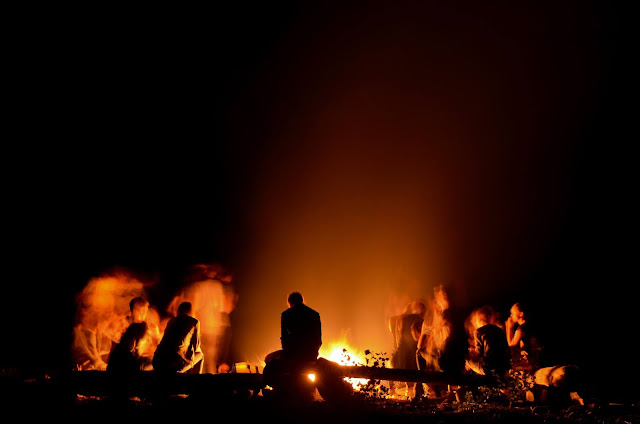
Deep in the forest... tents are pitched around a crackling bonfire. Those who you love and trust are sitting on logs, eyes sparking, as they anticipate your story.

You lean forward, with eager eyes, and say one word.

Then, you say, "No, scratch that." And then you utter a whole sentence.

Then, you say, "No, I didn't mean that. I meant this."

And through your umpteen restarts, everyone has yawned, stretched, shook their heads in disgust, and gone to their tents.

Story time by YOU ended before it ever began.

Would you tell a campfire story that way? Nope. You wouldn't. You would just start to talk and keep talking until the story ended.

So, why should you start any story in that confounded way? There's no reason at all.

~~~

You've obviously seen your story unfold in your mind's eye. Simply tell it. Hit the keyboard. Imagine those loved one's sitting around you, and type out your story. No fitful starts. To take backs. Just begin typing what you see, and worry much, much later how it looks.

Too many new writers obsess about articles that push the need for that perfect first line, that perfect first page, and that anything less will make you a literary failure, to the point you freeze your mind and become incapable of telling that story at all.

Do you seriously think sculptors re-affix their chiselled-off pieces?

Do you think painters paint that first brush stroke, then, ad nauseam, keep wiping it off?

At some point, you have to trust your brain, your own imagination, and your ability to tell a story.

What you should wipe from your brain, if anything at all, are those so-called article experts giving you mental fits about creating that perfect beginning.

Art is messy. It's undefined. It has to be attempted, roughed out, before it can ever be refined.

Heck, come that last page where you type, The End, your outlook on the beginning of your tale maybe vastly altered from what you foresaw months, years ago, so why obsess at the beginning when your literary journey has only begun?

Don't. Just don't. STOP obsessing. Seriously.

Write what your mind's eye sees. Get it down on the page. Write one scene, then the next, and keep writing until you type, The End.

Your goal right now is to be able TO write, and finish that book. Don't let others mess with your vision, your creativity or your confidence by what they "think" you need to do.

HOMEWORK: 

a) If you're just starting out to write your book, write that first line, that first page, without thinking. Tell that campfire story. 

b)If you're past the first page, STOP returning to it and changing it. Write on. That so-called perfection can come after you've written, The End. (Spoiler Alert: Mr. Perfection will never show up. That sucker is always a no-show. Don't put out your fine china for that idiot. He's not worth it.)

16 November

Self-Edit Method - Set, Do, and Forget It...


Self-editing...

Oh, have I witnessed some horrendous, excruciating attempts by new writers... 

They pick and prod and backspace and retype and correct and search, and hem and haw... FOREVER. I literally grow old just watching the effort.

I get it. New Writer Doubt. You carry truckloads of that stuff on your shoulders, 24/7. It's a wonder you can pick up a pen at all. How do I know what's on your shoulders? Because I've had that very same pack sack on my back, and in no way does it help you go from draft to donesco with that manuscript.

Here's what you do:

You set a method in stone. You decide that there will be these editing steps you must undertake with each work, and you complete those steps, one step at a time. And when you get to the end of that list, you STOP editing.

I'll type that again...

YOU STOP EDITING. NUFF. NO MORE. ENDSCO. DONESCO. FINITO.

And once you are done, then you hand the manuscript over to a professional editor to gloss. The experience you have with that editor will be a learning curve as steep as climbing Everest, BUT you'll come away from that exercise like a brand-new writer, a GOOD one. You'll thank your lucky stars. Just be careful who you choose. As in anything in life, you get what you pay for.

Back to the Method...

You can arrange the timing/order of these steps however you want, but these steps are non-negotiable, if you want to do this self-edit right and not repeat ad nauseam. And those steps are:

  • an analysis edit of the entire manuscript with a professional program. I recommend Pro Writing Aid. If you're serious about this writing gig, get the lifetime membership. It won't break the bank, but it will save your bacon in all your future edits. In this edit, check for Glue Words, Sticky Sentences, Repeating Words/Phrases, etc. Any weaknesses you know you have as you write drafts. Pro Write has a vast Menu you can choose from as analysis tools.
  • an on-screen reading edit - wherever you stop in your reading or your attention trails off, there's a prob. Fix it.
  • a hard copy print/edit you ROL - Read Out Loud - yes, I know, you don't want to print out your manuscript, but you really should, so you can get away from that screen and see the book in a whole new light. And when you ROL it, gaffes will pop out at you like flying popcorn, and you'll wonder what drugs you were on when you wrote the draft! I recommend a hard copy ROL every 30-50 pages until you finish the MS. You CANNOT ignore the ROL, peeps. Yes, I know, it makes you feel like a weirdo. Fun Fact: You're a writer. Of course, you're weird! Now, that we have that settled, ROL, already!

HOMEWORK: Set up your self-edit method today. Arrange the time frame for those steps to suit you and your ability. And go through each until they're all completed, and then DO NO MORE. Seriously, stop it, already. You've done all you can do with that manuscript. Now it's time to hand it off to a pro. And after the pro is done with it, and you've made the appropriate re-writes, that baby is ready to be published! Really, no foolin'!

No more hemming or hawing, or second-guessing.

Your work is done, as done as humanly possible, as any work can be.

Now you have permission to enjoy the fruits of your labors, and start a brand-new work. Huh, fancy that. A second book. Whodathunk?

02 November

Write Short Stories to Write Books...


Fact: Most people who start writing a book never finish.

'Why is that?' you ask.

Because they never became skilled at finishing a work. Over and over and over again.

Crafting the Critical Start. Through the Mushy Middle. To the Climactic End. Resulting in the Dénouement, or Resolution.

Beginner pianists know the drill. They play the scales... up and down, and up and down, and up and down 'til their fingers bleed.

Beginner welders know the drill. They clean, tack and bead, clean, tack and bead, clean, tack and bead.

Bakers know the drill. The gather the dry ingredients, the wet, sift and stir, gather, sift and stir, gather, sift and stir.

Are you sniffing the drift, here, peeps?

It's because you never practiced completing a work over and over and over again that you can't finish a book. 

A flash fiction piece, a short story, a novella, a novel and an epic length tome have something in common: Crafting the Critical Start. Through the Mushy Middle. To the Climactic End. Resulting in the Dénouement, or Resolution.

In my writer's process group, I had the members finish a one-page flash fiction story, to be handed in at the following meeting, two weeks later. And I had them complete this task all year long. We'd hand them out, read them and offer constructive feedback, and slowly, slowly, slowly, every new writer became better and better and better, and produced faster and faster and faster. By the time they tackled their book-length work, they knew the plot/character evolutionary drill, like a pianist knows the scales, like a welder knows to solder, like a baker knows to mix.

The old adage, You need to write a million words before any of them are good, kind of holds true, as long as with plunking down those words you COMPLETE works; however long or short, in whatever topic you choose. Your brain needs the formation practice. You need to crawl, then walk, before you can run, right? Why should writing a book be excluded from this universal human experience?

HOMEWORK: Set yourself a goal. Produce a one-page flash story that has a beginning, middle and end, on any topic other than your book topic, and know your deadline for each is every two weeks, and do this for the next year. IF you are determined and diligent enough to improve your craft, take up this dare. Remember what your Mom said? "Practice Makes Perfect." (Yeah, *sigh,* I'm sticking my tongue out, too, but darn if that great woman knew a thing or two...)

I assure you that you and your future completed book will thank me, and your Mom. 

Until then, you may make a voodoo doll in my likeness. I have a high pain threshold for pins. ;-)

19 October

The Importance of Writer To-Do Lists...


Yes.

I know.

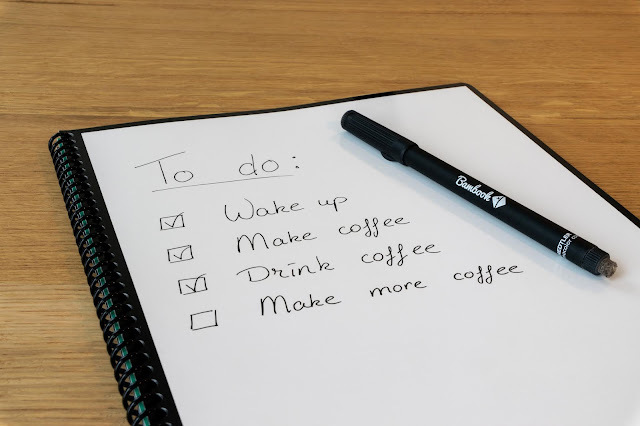
Today's topic is not sexy or romantic or adventurous in any way. It may have only come in above watching paint try. But it's an exercise that few new writers complete, and before you can complete your writing goals, you need to know what they are, on a daily basis.

A writing To-Do list is the key.

It's a psychological contract with yourself — yes, there's that shrink-think again... — forcing you to a) decide what can be achieved each day on your book, and b) list those To-Do's in their most crucial order, so no deadline, manufactured or real, will be missed.

Hold on! Don't X me out yet! Get back here! 

This isn't rocket science. You seriously think I'd be doing it, if it were? But it truly is important IF you want that book of yours done.

This exercise does NOT entail a great big ugly effort on your part. In fact, the easier you can formulate it, the better. NO sticky notes. NO knitting string. NO Excel sheets. NO graphs. NO charts. NO nothing complex. PULEEZZZ, we writers have enough headaches! 

I just downloaded the free and easy to use Color Note app on my cell phone. The simpler the note, the better. In this exercise, FEWER bells and whistles is best.

Start with the date:

  • then add each To-Do on its own line
  • only use a few words to describe each To-Do
  • line up from most crucial to least or,
  • quicker ones at the start, longer ones at the end
  • and only have, at most, three writing To-Do's set up for each day
  • or the amount of To-Dos you know you can reasonably complete in your writing session
Don'ts:
  • Don't over pile the To-Dos
  • Don't assume it takes less time to complete each task; it'll take more. Double the time needed.
Do's:
  • At the end of each writing day, delete/line out the tasks you've completed
  • Re-evaluate the time it took to complete those tasks
  • Move the uncompleted task(s) to the next available writing session
Sunday's:
  • If your writing work week begins on a Monday, use Sunday to plot out a week-long To-Do list
  • Attempt to spread the bigger projects out, paired with smaller To-Do's
  • Segment those big projects into doable daily sections
This exercise should only take you a few minutes, at most, but it will save you so much time and wasted energy and the stress that comes from Decision Fatigue. Yes, DF is a real thing. If you have to make too many decisions in a day, on top of the word choice decisions every writer has to make to even formulate one sentence, that fatigue will set in, and that pathetic choo-choo train will stop at Writer's Block Corners, if you get my drift.

So, eliminate the Big Picture decisions with your To-Do List!
 
I can wake up and look like a zombie (hey, no joke), glance down at my list, and know exactly what I'll be doing once the caffeine kicks in. I don't have to hum and haw about what needs doing. I simply start completing those To-Do's.

Back to that psychological contract...
  1. If you put your tasks down in writing, it has your mind re-think their importance. If you leave those tasks up in your head, they never become a real thing; hence, you never take them seriously, and they never get done.
  2. By putting your tasks down on paper, virtual or real, it frees you up from the cyclical worrying that will keep you awake at night when your mind and body needs to rest. You assume that the moment you write those tasks down, you're free to stop thinking about them for the night. You know you'll see that list again come the morning. It's a way of not taking your work home with you, so to speak.

HOMEWORK: Tonight, formulate your list. Don't overload that list. Assume it'll take you twice as long to complete each task. Over time, you'll better gauge the time it will take. And at week's end, set up the daily tasks as you see them ironing out for the next week.

If you do this one simple thing, and keep doing it, your book will get done, quicker than you ever thought possible, and without that choo-choo train stopping at Writer's Block Corners. 

Don't stop there. The station food is horrible, and the station master is a meanie. ;-)

28 September

Character Bibles - Writer's Block Solution...

Courtesy Pixel Curse

On this site, I've touched on character development before — How Long Have You Spent with Your Characters? — but I've not covered the issue enough, as per my experience completing books.

New fiction book writers often feel they are in a race with other writers — their first mistake.

Every book has its own timeframe, and if you create and maintain a writing schedule, that book will get done. If you try to rush through the process, there will be a lack of knowledge on what and how to write that will create undue stress, that will lead to writer's block, often having that writer abandon the project altogether.

Sound familiar, peeps?

There's one, and only one, solution to this problem: STOP writing. START filling out Character Bibles.

  • Do you know what they are?
  • Have you filled them out?
  • Have you taken the time to truly get to know your literary peeps, because in terms of your story, they ARE real people, you know.

Now, I'm NOT talking wasting time, playing with worksheet to avoid writing. I'm talking that before you even write one word, you've allowed yourself TIME to acclimate to/get to know these people, so much so that the prose/dialogue/action virtually writes itself. 

Yes, I'm not kidding here. If you know your characters deeply enough, and the book will write itself.

Returning to that harried newbie scribe scenario...

So, because our newbie writer is worried about keeping up with the literary Jones's, they plunge into the manuscript knowing next to nothing about the people who will carry this tale. Don't let so-called experts fool you. Stories are about people, not about plot. Yes, in action adventure tales, the locales, the events drive the narrative, but even in those books, it's about the unique traits of those characters that give life to the tale.

Ergo... not knowing the characters = not knowing the story = not having the foggiest what to write = Writer's Block. (Don't you just WUV how I'm a genius with literary calculus? Please tell my Grade 11 math teacher, won't you? ;-) )

HOMEWORK No. 1: go online and find yourself a GOOD bible worksheet. 

For my last two novels, I've used story consultant, Lara Willard's worksheet, which I believe is one of the best out there. It's two-sided, and covers all the areas needed to fill out your character's personality (click the link below to send you to her page to download the PDF worksheets). If I have several main characters, I'll research online for a photo that is like what my mind's eye sees in that character, and I'll attach it to Lara's worksheet. Once you've filled out this form, honestly, and completely, and sit with those character traits in your mind for a few weeks/months, there won't be much you won't know about your book peeps. In my last novel, I had SIX main characters, and Lara's worksheet was invaluable to get me to write authentically and uniquely about each one.

Lara's Character Bible Worksheet

HOMEWORK No. 2: Once you've downloaded your favorite worksheet, begin to fill it out. Research for the correct and full answers. Write down what you know now, but don't worry if along the writing process, some details change. It can happen. It's happened with my characters as I get to know them better over time.

TAKE THE TIME NEEDED to know these people, for if you skip this process, your brain will not know what to write. It's as simple as that. If you do take that time, and you know these people inside and out, I guarantee you your fingers won't keep up with your thoughts, and virtually every sentence you write will be legit, authentic, unique and vibrant, needing very little edit at draft end.

Book writing is NOT a race. Please drill that into your self-conscious new writer head.

  • Each writer has a speed. 
  • Each book has a speed, too. 
  • And characters will formulate in front of your eyes at their OWN pace, as well.

Don't skip this process. Don't use it as an excuse not to write, either. But do the work, NOW, to save you writing heartache later. By slowing down and doing the necessary backstory work, you'll actually finish your book sooner. Seriously. Not all you know about your characters will end up in the book, but that knowledge will help you craft rich, deeply moving prose that your readers will appreciate.

Once you've acclimated to their world, then, and only then, begin to write. You do this, and you'll end up saying to me, "Writer's Block? Never heard of it." ;-)

14 September

Not Writing? Return to the Scene Cards...


If you've been in a writing frenzy, your fingers not able to keep up with your mind, and then, all of a sudden one day, your fingers stop. Cold.

They won't move. They won't budge.

They're the equivalent of a stubborn mule.

You curse them. You talk to yourself.

"What the heck? Get going already! We're at that part where the feral rutabaga storms in on the alien monkey, and lasers are lifted, and—"

Nothing. Nope. Fingers don't care about that climactic laser duel. Couldn't care less. Fingers close the laptop, and they walk away and go make a coffee and pick up an Archie comic to read...(hey, don't laugh. I love Archie comics! I also love War & Peace. I am a complicated weirdo...)

"What is the deal here?" You ask.

I answer, "Back to the scene cards, dear writer of tales."

Writers need to know more than how to write books. They need to read their own minds. Your brain is not only a powerful organ, but a protective one, too. It won't make you do something you're not equipped to do.

If your writing was going great and then stopped cold, chances are it's because there's,

  • a) something wrong with the next scene, or
  • b) the next scene you've created isn't fleshed out enough for your mind's eye to see it, to translate it to those fingers.

Stop trying to write. Proactively engage in the writer process. There is one, you know...

Go back to your scene cards. Lay them all out in a linear story fashion. And take a hard look at the story arc. 

  • Is a scene or scenes missing? 
  • Are characters missing? 
  • Is the next scene needed? Relevant? Is it just an Info Dump?
  • Are the character motivations right?
  • Am I missing dialogue here?

If all's well there, then look at the next scene card you've yet to write out. 

  • Brainstorm to expand the details of that scene. 
  • Make sure, like a book, it has a beginning, middle and end.
  • If more research is needed, do that. Maybe there are details you need to know before further writing can begin.

Chances are, when you return to your scene cards, something in the plot/character evolution/devolution is off, or you're missing a scene(s)/scene details to continue the story.

I'll guarantee that once you complete this exercise, your brain will again be on fire, and your fingers will rush to keep up.

HOMEWORK: Trust your brain. See it as your friend, not your enemy. And hit those scene cards and further flesh them out, and watch your finger dance begin again.

New writer doubts, fears, often include a mistrust of our brain, when nothing of the kind should exist. The more you trust your brain-to-finger writer process, the less stress you'll have, and the more the tales will flow out on the page. I guarantee it.

P.S. Tell your fingers to make another coffee. This one is cold. ;-)

07 September

Writer Evolution - Pantser to Plotter...


I can see the pantser rioters forming outside my house... pitchforks in hand, chanting, 

NO GO PLOTTER FOE! NO GO PLOTTER FOE!

For a second, I thought to invite them all in for coffee...

Instead, I decided to write this post. Their chanting inspired me...

Here's the beef:

It's not HOW you write your book that counts, IF that process gets you,

a) writing consistently, and

b) doesn't get you in an editorial firestorm.

Before I begin, let me say that there is a very small group of writers who are experienced enough to craft an entire novel in their head before they hit the keys. They have had years crafting similar books or years experience in the literary field. Those novels are usually genre, plot recipe driven. A good example I've cited before is Ian Flemming with the Bond books. He'd suntan on his beach and work out the skeleton of the next book, then head inside and plunk it all down in one go.

Those rare breeds are NOT who I'm talking about here. Who I'm referencing are the inexperienced pantsers who don't have a clue about what they're writing. They literally just start plunking out a stream of consciousness that has by definition no structure to it.

Their excitement for this daredevil approach might satisfy "a" above, but will usually trap them in "b," in a mess of plot black holes or corners they can't extract the characters from, and characters whose dialogue and actions maybe superficial, cliché or improbable.

So, although they are a typing storm, it's "b" that'll get them into a world of hurt after the pantsering fun has ended, and a real story must emerge from that frenzied approach.

IF YOU are experiencing "a" and/or "b" issues, you need to evolve as a writer.

You need to become a sponge, and assume by default there are better ways to write than you presently know, and are using now. Writing, like any profession, takes skill, and that skill you are not born with, you amass over time, often heeding the words of mentors who have come before you, and know the best route to book-writing success.

In my experience, new book writers are the most close-minded, the most stubborn, the most unwilling to change, when it's that segment who should be the most open to new ideas, especially if their ideas aren't cutting the mustard.

Having said all that, I am NOT telling you to know every inch of your tale before you write. What you need is to know the major scenes and the character actions/motivations within those scenes — the general points to get your writer mind VISUALIZING the unfolding tale, so your fingers will type out a draft that you CAN work with, you CAN flesh out and refine, versus a hornet's nest of plot/character black holes that'll get you pulling out your hair and dropping that draft, never having it come to finished book fruition, which when it comes to pantsers is, sadly, the norm rather than the exception.

I once had a colleague who refused to listen to/consider new process ideas. That person would literally put their hand up in the air as a visual stop-gap to say there was no way they would adopt any other way but their own - a full fledge pantser. 

That same colleague ended up editing their draft for YEARS.They so over-edited it that it eventually read as sawdust. They had effectively edited away all the passion out of the tale.

Instead of ending up in that mess, consider YOUR process...

Is it working? Are you writing consistently on your draft? Is it going down on the page, making sense? Is the plot line logical? Are the character's words/actions genuine to their personality/story arc?

If not, it's time to become a sponge, willingly adopt new ideas, and evolve into the productive wordsmith you so eagerly seek.

To improve as an artist, acceptance of CONSTANT EVOLUTION is a must. You must accept that the ideas, beliefs you started out with will never be the best, for beginning beliefs in any new endeavor are never the best. You need to be willing to change, modify, and refine your process, or drop your process altogether if a) no words get down on the page, and/or b) no cohesive tale is resulting.

The day you put your own hand up in protest to new ideas offered by mentors is the day you're doomed as an artist. You and me, both.

As I've mentioned before, we are all on the same literary ladder; some below us, some above. The ones above have experienced more, failed more, succeeded more. Their wisdom can guide the lower rungs to better, faster succession up that ladder, so LISTEN to them, HEED their words of advice, and be willing to change.

If you come away from my blog with only ONE adopted action...

BECOME A SPONGE. 

Soak in every ounce of advice, information, warning signs to which you are exposed, and ask yourself, 

"How can I reverse engineer that kernel of wisdom to see how it can work for me?"

"How can I examine its success rate with other renowned authors?"

"How can I adapt it to my process?"

Do not become a fervent pantser for the sake of tribal loyalty. That to evolve into a competent plotter will somehow steal the joy. What will actually happen when you adopt a more competent process is your story will unfold into a quality draft that can be edited in weeks, not years, taking that tale from a manuscript to a real book, a real gift to the world to enjoy or to learn from, instead of a red pen mess stuffed in the back of your drawer. And isn't producing a real book where the writer joy truly lies???

HOMEWORK: Tonight, look at your draft. Ask yourself, when was the last time I wrote on it? Is the storyline making sense? Are the characters vibrant, wholesome, genuine people? When you ROL — Read Out Loud — the draft, are you stumbling over the words? If any of your answers shine a negative light on your draft, then it's time to drop your beliefs for something that will work. 

Consider becoming a plotter, as in my previous post, Book Outlines, Scene Cards an Option... adopt a scene card approach to your tale, and start a NEW draft with those cards. You don't have to delete your old draft, but if you begin again with those cards in mind, you will write faster, better, and I guarantee you, you'll realize that old draft is no longer needed. You've written a better tale the second time around.

A hiker can't get from A to Z without a map, and neither can the productive book writer in you.

Open your mind, and evolve, to create great art. That's the only way great art is ever done!

24 August

That Story in Your Head - Say It Out Loud...


I hear from writers all the time that the story they had in their head was utterly fantastic... until they plunked it out on the page. Then, it died a horrible, boring death, so excruciating to witness they never finished the work, repressing all memory of the literary attempt.

That's one way of embedding negative thoughts, wee story hack that you are, so the next time around, before one word is even down on the page, you're already in a bad way. Good for you... not.

If this sounds like an experience you've lived, flip the process!

Before writing, 

  • SAY OUT LOUD to yourself the entire story as you know it.
  • If possible, record your words.
  • Play the recording back, and truly listen to your tale.

Is your verbal telling equalling your muted thoughts?

  • What's different?
  • What's the same?
  • What sounds right?
  • What's sounds wrong?

Oftentimes, when we say things out loud, our consciousness wakes up to accurately assess the telling, and we begin to recognize the RIGHT word choices and notice the story gaffes merely by speaking the tale. It works for entire plots and for singular scenes that give your grief.

Remember: this is how man first conveyed stories. It really should be our default go-to, to, well, find the faults, and the gems, in our tales.

Story plot/character black holes will also pop up, warning you that more creative work needs to be done on your outline before you begin to write.

New writers assume that to be a writer is to be a mute and still artist, when it's actually the opposite. 

  • Action scenes should be blocked out by the writer physically acting out those scenes. 
  • Dialogue should be said out loud, in the manner in which a character would utter those words.
  • Locale description should be viewed in similar surrounds, talking a walking 360 in that set, or if not possible, viewing a similar video/movie/stage play, etc.

To be a writer is anything but being stagnant. A writer needs to LIVE their tale, not merely be a distant bystander, and saying your tale out loud to yourself is a great, first step in accurately conveying that storyline, to get its vibrancy down on the real-world page, not merely lying perfectly in your inanimate head.

Yes. you tell me, you feel dumb doing that.

And I say, being weird, dumb, silly — that's a writer's DEFAULT personality, peeps. Embrace the weird! Not doing so won't eliminate your weirdness, my fellow hack. It'll just closet that beast instead of letting it run free on the page where it belongs.

HOMEWORK: Tonight, say your tale out loud to yourself. Record or write down those gem phrases you utter. Make notes on what works and especially what doesn't in your telling. It'll free you from your writer stress and open up your creative mind. Do it in a closet if you must, or be like me and give your neighbors something to talk about when they catch you acting out your tales in your back garden!

Go be weird. Your stories will be glad you did.

29 July

Dear Book Writer, Just Say STOP...


STOP.

A pretty big, small word.

It warns us of impending danger ahead, to pause, look around our space, and be on alert, and only after we see the coast is clear, do we move on.

The voice inside your head is the dangerous one. It keeps whispering why you cannot write on your book today. Umpteen different reasons, excuses, colorful pastimes that your voice mumbles in your ear...

"I can't write today. I have to do ___."

"Writing? Now? Are you kidding! ____ is waiting for me." 

"Oh, yes, I was going to write, and then ___ happened, and I couldn't."

Blah-dee-blah, blah, blah.... yatta, even...

The Key: Have you asked yourself the REAL question? Is my brain a danger to me?

Sure, the flip side to that argument is your brain is trying to protect you from danger ahead, from committing mistakes or being laughed by your book readers. But do those dangers really exist? Could it be your Ego whispering to you, niggling at you to stop being a fool by writing on that book, instead of your reasoned mind?

A writer, like anyone undertaking any métier, has to judge what a) is a real danger, and b) when to STOP for what.

If your inner voice is a danger to you by offering up a plethora of excuses not to write, then you need to sit up, plaster on a stern expression, and say out loud, and with conviction, to your fearful self, "STOP, just STOP IT."

This audible trick works. It tells your Ego to shush it, to go back into its narcissistic cave and be quiet already, as you have legitimate work to do.

On occasion, I've needed to express this order to myself when my Ego rears its ugly head and tries to stop me from producing. Right now, I have a huge list of new book projects, and tickling my brain is that evil-doer, whispering in my ear why it's much safer not to open my laptop and add more words to those manuscripts. But soon enough,

  • I literally get fed up with that whispered BS.
  • I sit up.
  • And I say out loud, "STOP IT. Just STOP."

Those spat out words jar my psyche to realign my definition of danger, to ascertain there isn't any, so I can move forward, open up my laptop, and start writing again.

Sooner or later, you, like me, will have to contend with those opposing forces — the Ego and the Writing Mind. No shrink in the world can tell me those two are one and the same. They are not. It's a Battle Royale to the finish with each manuscript. 

The Bad News: That Ego beast never completely goes away. It lurks, lays in wait, breathing heavily... (frig).

The Good News: Your Writer Mind gets stronger, and wins more battles over your Ego, the more you write (yay!).

MY ongoing battle:

  • My Ego is all up in my grill because it doesn't want to be seen as anything but perfect to the outside world. Pathetic Ego.
  • My Writer Mind KNOWS I've written well before, many times, so realistically I'll write well again. Cheers, for the mature me!

As a new book writer, you have to come to this realization yourself, that you are fighting a foe that's only in your imagination. And with each new book project, it will whisper again to you to do anything but write on that manuscript. The bigger, more mature, adult you must stop that Ego monster in its tracks by simply saying out loud, "STOP." It will hear that word, finally shut up with the excuses, so you can move to open your much-abandoned laptop or notebook.

HOMEWORK: Try this small exercise the next time you hear your Ego whispering to you. Try it TODAY, TONIGHT, if instead of writing on your manuscript, you end up:

  • doing laundry 
  • vacuuming
  • playing video games
  • Facebook scrolling
  • fishing lint out of your navel.
You'll be amazed what your mature mind can do, say, to get you to stop for the real danger — that lazy lout, Monster Ego — and instead move forward on your book. 


P. S. It's okay to give your Ego a name. Mine is called Barbarella. She's a hot mess and leaves a wake of trouble everywhere she goes... 
 
Before I sat down to write this article, I fed her a dose of  ZzzQuil. She's snoring contently. ;-)

27 July

Fail Lots Now, Succeed Faster...


Failure. 

It's a word most people shun, fear, dread.

If you're willing to alter your opinion about this term, this result, you'll succeed as an author greater than your wildest dreams.

My Mindset Altered View on Failure:

I think of failure like a game of pub darts. (Hey, so sue me for being of Northern Irish descent where everything in my life originates back to cocktails, that may or may not include Guinness. At least I'm being honest here...)

You have a board. You have darts. You throw those darts at the board. Some... many... scads 'n' scads... hit at awful board scores. But the more you throw, the better your skill at throwing gets, and your chances grow that you will hit a bullseye... not just once, but regularly, to downright often, as your attempts to throw grow.

Question to You: How many awful dart hits did a champion dart player make before they became a champion? Guesstimate: Thousands, maybe tens of thousands. Right?

Question: How many word choices do YOU have to make before your word choices are consistently stellar???

Time to Success Ratio: The quicker you make scads of awful dart board hits, the sooner your skill improves, the quicker your throwing action becomes consistently high-scoring! Now, trade dart throws for word choices. Seeing a pattern here?

Back to Your Book...(Leave your empty beer glass on the bar. Thanks.)

So, here's the deal I'm making with you... decide to WELCOME ABJECT FAILURE... in every word you choose, every sentence you form, in every paragraph and chapter you finish in that unfinished manuscript of yours. 

Yes! Make a dart game of completing your book!

Plunk down word, after word, after word, ASSUMING, EXPECTING, TRUSTING your choices are the most awful any breathing human being could ever make. AND PURPOSELY WRITE DESPITE!

The quicker you barf out all those icky words, the better your mind will hone its decision-making skill, the quicker the fear of failure ebbs as the better your word choices become.

Told ya book writing isn't difficult. It's fighting to retrain your mind that's the toughie.

Mindset Change Today: WELCOME FAILURE!

HOMEWORK: Today, DECIDE to allow yourself to fail, to royally screw up, to indeed DARE YOURSELF TO FAIL. Wildly plunk down words, as a newbie darts player throws pub darts at the board. EXPECT to read hilariously chosen words and phrases that after you edit the draft and become a seasoned author, you will look back on and howl, and be DAMN PROUD YOU HAD THE COURAGE to FAIL LOTS THEN, so you MASTERED FASTER.

(FYI: I pull out my first year university nude model charcoal sketches at cocktail parties for the most unbridled howling you'll ever hear from inebriated guests. And I believe my first story every written was written by a frontal lobotomized monkey. Monumental fails, much, there, BJ? ;-) )

The Key: The quicker you get over your fear of failure, the quicker you simply won't fail. 

Psychology, peeps, as I continue to harp on this fact, and will until the day I go to the Big Typewriter in the sky. Your book writing difficulties live in your mind, not on the page.

Question: If you're SURE to fail at writing your manuscript, what's stopping you now from writing your manuscript?

Answer: Absolutely nothing.

Go fail!

22 July

Book Writing Naysayers... Don't Listen

Family. Your well-heeled, Aunt Mable. 

"Oh, Jane, that partial book draft you sent me to read, so sweet. How long have you been working on this story? Years, you say? Dear, that's a lovely pastime, but it'll never pay the bills. I told you to marry well. You ignored me, and married that deadbeat. You need a real job, as you're now my least favorite relative, and I'm leaving nothing to you in my will."

Friends. Your bestie, Carol.

"Wow, you've been writing? I didn't know that. What a secret you've been keeping, for, what did you say? Years? Uh-huh. Listen, I know a guy who can get you a discounted rate on a course to sell real estate. Now, there's some big earning potential. Great story though. Read it to your future kids sometime, if you can afford to have any, that is."

Colleagues.

You work buddy, Bob.

"Cool! A whole manuscript! Oh, an unfinished book. Right. Gotcha. When will it be done? You don't know. Right. Hey, listen, my wife is having a Tupperware party where you can become one of her sellers and make millions! Text me with your RSVP. And listen, great job on that, whatever it is book thing. Sounds great. Great conversation starter at my wife's Tupperware party. Don't forget the RSVP!"

~~~

It's not that they don't love you or like you or even tolerate you, as long as you do what is expected in an average life, what they themselves can only do. 

Deep down, they know you'll never finish that manuscript because nobody they know tries that silly game and wins. They'll smile and nod, and gently guide you into being anything but a writer because success is only defined as getting quick cash, and lots of it, and they know you're never going to get any moolah being a writer. They'll probably pat you gently on your shoulder, too, and quickly walk away exhaling deeply, thankful they aren't you with that silly pipe dream.

Firstly, who ever achieved greatness accepting the average, the mundane, the predicted?

Secondly, why should others, who lack courage, stop you from having some?

Along that naysayer belief then, 

  • Ernest Hemingway would have died a poor deep sea fisherman.
  • Truman Capote would have retired as a copyboy for The New Yorker magazine.
  • Agatha Christie would have been a bored housewife.

The Reality: Something is giving you this itch to write. The idea haunts you every day, and that itch, that haunting, will not subside. Maybe it's the universe, far above, far greater than those earthly naysayers, trying to tell you something.

The Key: It will take all the courage you can muster to finish that book, but finish it, you must. You know it. I know it. It will be the only way to shut up those nagging, "WRITE!" voices inside your head.

HOMEWORK: STOP telling people about your story. STOP talking. START WRITING. Materialize in a book what has breathed inside your mind for such a long time. 

  • Keep your eyes on the page.
  • Keep your ears shut to that naysayer world.
  • Focus on your storyline, writing out one scene card after another.
  • And slap down ALL the words needed to finish that draft.

Courage. Fortitude. Discipline. Confidence to go it alone until the piece is done.

It's far more important to listen to the universe. There's an unbelievable future waiting for you that will NEVER be waiting for those naysayers, and it lies on that blank page, looking up eagerly at YOU.

Question: Now, look ME straight in the eye, and answer me this: 

Do you have what it takes to go for greatness?


20 July

Permanent Student, Never Writer...


How many How-To Write books have you read?

How many hours have you spent reading those books?

Has that hour tally equalled your actual book writing time?

I'll guess the answer is a no way is hell.

Picture yourself the kid you once were... did you read a gob of theoretical books on how to ride a bicycle before you tried to ride a bicycle? Or did your parent give you the main pointers — the ins and outs of how to stay balanced and keep moving without kissing the ditch — and then did they plop you on the seat, give you a hefty push, and you were on your wobbling way, that with much practice and your fair share of knee-scraping falls, you found your bike-riding groove?

Rrright...so why should book writing be any different???

Yes, bike riding isn't writing, but it kind of is...

  • You have an idea for a fiction or non-fiction book.
  • You have the theory down as to formulating a story line.
  • You've done your backstory and character research.
  • Your command of your language is sound enough with the help of an online editing program, mentor, and/or a beta reader.

No other writer How-To's will get you knowing anything more than sitting at your desk and plunking down words on the page, however clumsy you may think their order is. At some point, you have to sit on that bike seat and start peddling forward.

Biker Rider/Book Writer Courage, peeps, knowing that as you go, spills will definitely happen, but you're emotionally ready to pick yourself up, dust yourself off, and start again.

My Advice: If you've read around two to five How To's, stop with the reading already, and start with the writing. Your theoretical knowledge is sound enough to begin writing your own book, and any queries you might have as you go will be better answered in specific ways, through writer forums,  a writers group, a writing mentor/instructor or beta reader.

Don't become a permanent student/expert theorist. Those titles won't get you a published book.

It's time now for you to ACT on that knowledge and mire through the muck with the rest of us literary grunts who write and rewrite and edit and re-edit, and groan and moan and exhaust our minds to a final finished product. The life of a writer is anything but perfect. If you want perfect, draw cartoons. The cartoon world is perfect. Nothing else in life is.

HOMEWORK: Shelve all those How-To writer books, and start writing on your book tonight. The only way you'll fulfill your book writing dream is to start writing. In the end, nothing else matters.

P.S. Stephen King didn't have his own How-To Writer book to read before he started writing. At some point, the bespectacled dude started humping like the rest of us, right??? My advice is, do what he did, but without the drugs... ;-)

15 July

Writer Fear, Writer Doubt - Psychological Catatonia


How many of you here have still not opened your notebook or laptop to start writing again on your WIP?

If you're still stuck, go back to my 5-Minute Game article posted earlier on this site, and reboot your mind. (Click on the Sitemap to locate.)

The fact you are still mired denotes a psychological catatonia — fear and doubt, the two evil forces, have taken your brain hostage. You need to acknowledge their presence, and write on despite their weight upon you. The only way to win against those forces is through ACCEPTANCE of their existence, that they will be there as you perform for the rest of your life, as an actor faces stage fright every time the klieg lights turn to face them.
 
No artist is immune. No producer of any kind is immune. Acceptance and practice to open that notebook or laptop and write/edit through that emotional pain is the ONLY way.

Comment below what progress, if any, you're reached in your book writing journey since you've signed on with me here. Let's uncover the obstacles to find ways around them. Every problem has a solution if you're willing to look, and do the emotional work.

No obstacle is silly, and this is a safe place to talk.
NO judgement.
ALL help.

Let's get those words flowing...

08 July

Affix Horse Blinders - STOP Other Writer Gawking...


The last thing a new or struggling writer needs is another reason not to write, and I find such writers spending quite a bit of their time looking around at other writers and their works, and not down at their own page.

They interact with their brain thus, "How come I didn't think to write that story? How come they are doing so well, and I'm not? Why did they finish umpteen thousand words yesterday and I didn't even open my laptop? How come that writer is relaxed, laughing with her colleagues, and I can't even manage a smile?"

And on, and on, and on.......

In a horse race, the horses wear blinders —larger pieces of tack — that prevent the horse seeing to the rear or the side and being distracted by the other competitors, ensuring top focus and therefore top speed. If the horse spent his time gazing at the other horses alongside him, his attention would wander and his speed would greatly diminish.

Accept that as a writer in a field crammed with other writers, you're that horse.

All you need to look at is your own mind's eye for the story conjuring and your fingers pounding down those storied words.

The only time you should come up for air and rejoin the literary world is when your writing session is done for the day. You've in effect run your own race, covered the proverbial track, and laid down the acceptable number of hoof prints in your mighty path moving forward.

To run this daily solo race, you need to shut the world off. 

  • STOP gawking at others. 
  • STOP looking at what they're doing, or not doing. 
  • STOP analyzing their work and start creating works of your own.

You are you. You are the One and Only you. You aren't them, and they sure as heck will never be you. Neither can you copy what they do in life, and neither can they copy you. Your way with words, your brain process of ingesting experiences and weaving them into a tale, cannot be replicated by a single other human being. So where's the panic about the competition??? There shouldn't be any.

Your art starts and ends with you. You literally have zero need, zero impetus, to stretch your neck out to view others and their works in progress.

I'm not saying don't be encouraging of others. Absolutely, when the writing day is done, confab with colleagues and vent your writing experiences and celebrate the successes along the way, but when it comes to art creation, those horse blinders had better be affixed, so you can't look around, focusing instead on your own literary path.

As an example:

I write alone, in a completely quiet house, when I'm in a session. There is no web browser, no TV, no radio, no people around me distracting my attention from my writing flow. Not until the work is done do I resurface into the noisy world, and rejoice in that noisy world. 

P.S. Even if your house is a zoo of activity, find a place where you can go that distraction is at a minimum. Everyone can find that place for a short while each day. NO excuses.

I don't waste my time wondering what the next writer is doing, for I'm not them. I realize it's a complete waste of time to mind game about The Other Writer. I will enjoy their works when I read them and marvel at the complexity and diversity of humanity, but that's as far as the outer world enters my artistic universe, simply because it physically can't, and attempting the impossible will only waste my time and help me not along my own artistic path.

If you do this — accept that your work is unique — you will drop the need to look around and ask yourself all those silly questions that will only increase your doubt and decrease your productivity. And that time saved not gawking or wondering or second-guessing can be tacked onto your writing session time!

Again, this is you, donning indestructible self-confidence as the artist you are. Back to the psychological again, peeps. No other artists can compete with what you do, so any urgency, envy, hesitancy, self-doubt simply fades away.

I'll do me.

You do you.

And after our separate words are pounded down on separate pages, lets both surface contentedly, confidently together.

HOMEWORK: What are you still doing here, reading me? Get to work! ;-)

06 July

Finishing Your Book - Your Second Full Time Job...

 Writing all alone at night, as your second full time job.

Question: How long would you last at your day job if you only came into work when you felt like it?

Answer: If you're reading this article now because you tried that yesterday, and today you're unemployed, well, there ya go.

A Tidbit of Reality: Nothing involving value — and by value I mean quality of work, reputation, revenue — is done by happenstance. Like... never.

You say, "But B. J., I have to work at my day job, so I don't end up in a cardboard box panhandling on 3rd."

I say, "So true. But what do you do that truly benefits your life when you're NOT at your day job? And those empty-calorie activities like playing video games, watching TV or clubbing doesn't count."

Crickets, gathering around us, say, "Chirping..."

"Right. So what was your question, again?" 

Don't get me wrong. Having a part-time hobby has a huge benefit to a person's quality of life, but if you plan on completing a major project that will be put out into society to augment their quality of life, your reputation and net worth, dabbling at it only when there's a snow storm or when your Aunt Mable loans you her creepy lakeside mansion won't cut it. 

In the former, you end up getting into a snowball fight with your neighbors. They invite you over for drinks post snow flaky fun, and after four Manhattans you slur, "Wad būk?"

In the latter, flies hibernating in the walls come to life as soon as you light the fireplace. They swarm around your head. You run screaming from the mansion, trip over a log, fall into the lake, and drown. Another writer far more serious than your deceased self witnesses your ghostly image, and with focused, steely determination writes a Gothic novel entitled, The Ghost on Missed Chances Lake, that when finished, and published, wins a Pulitzer Prize, and stays on the New York Times Best Seller list for 41,000 straight weeks, making so much dough that the lauded scribe, who isn't you, actually feels sorry for J. K. Rowling.

The time-tested adage, "Your muse finds you working" still tests positive today. 

The fact is, you simply will not write well until you write consistently. 

That 1/4 finished manuscript of yours will never become an actual book until you look at writing as your second full time job. You know, the moonlight gig you willingly take on for no cash and no fame... similar to that security guard job you passed over last year for no real money, far less fame, a skin rash from the uniform, and more income taxes paid... still with no finished book at the end.

If you're serious about becoming a novelist or non-fiction writer, you need to alter your mindset, you know, that psychological aspect of writing I keep harping on, and on, about. Your writing sessions have to be seen as your moonlight job that you willingly take on because you see the Big Picture — the real benefits of finishing that book — personal satisfaction, a gift to society, a lauded career, evergreen income.

You WILL have to sit down and write when,

  • You're too tired.
  • You're not feeling well.
  • When all your friends are going out and having fun, without you.

And that drudgery WILL have to keep on keeping on until you write the words, The End, and not one word before.

You WILL experience, 

  • Loneliness.
  • Frustration.
  • Hopelessness.
  • Mental Exhaustion.

But you WILL keep on, keeping on, until you write the words, The End, and not one word before.

You WILL accept that those feelings come with the job, and no amount of fame, money or multitude of finished books will make those feelings completely go away.

You ask, "So, why am I writing if all I get are those bad feelings?"

I say, "Because you're an artist. You have something to give to humanity. You endure because the personal satisfaction of birthing art and sending it out to the world supersedes all else, all the hard work, exhaustion, and all those lonely times. The work is greater than you. That's why."

Crickets crawl in closer, happily chirping.

HOMEWORK: Tonight, think long and hard about altering your mindset from a hobbyist to a person with a second full time job. Take your brain from happenstance writer to serious wordsmith, from once-in-a-while plot pondering to 24/7 sub-conscious and conscious book rumination. 

This is not only a mindset shift but a style of life change, peeps, and it's forever. You have to visualize yourself being serious with this métier in order to be serious with this métier.

Become steely-eyed. Keep your eyes on that publishing prize. Trade in that juvenile mindset for an adult take on what is really needed to be a professional writer. There is no going halfway in this career. Ask any accomplished writer.