Showing posts with label Red Pen Edits. Show all posts

16 November

Self-Edit Method - Set, Do, and Forget It...


Self-editing...

Oh, have I witnessed some horrendous, excruciating attempts by new writers... 

They pick and prod and backspace and retype and correct and search, and hem and haw... FOREVER. I literally grow old just watching the effort.

I get it. New Writer Doubt. You carry truckloads of that stuff on your shoulders, 24/7. It's a wonder you can pick up a pen at all. How do I know what's on your shoulders? Because I've had that very same pack sack on my back, and in no way does it help you go from draft to donesco with that manuscript.

Here's what you do:

You set a method in stone. You decide that there will be these editing steps you must undertake with each work, and you complete those steps, one step at a time. And when you get to the end of that list, you STOP editing.

I'll type that again...

YOU STOP EDITING. NUFF. NO MORE. ENDSCO. DONESCO. FINITO.

And once you are done, then you hand the manuscript over to a professional editor to gloss. The experience you have with that editor will be a learning curve as steep as climbing Everest, BUT you'll come away from that exercise like a brand-new writer, a GOOD one. You'll thank your lucky stars. Just be careful who you choose. As in anything in life, you get what you pay for.

Back to the Method...

You can arrange the timing/order of these steps however you want, but these steps are non-negotiable, if you want to do this self-edit right and not repeat ad nauseam. And those steps are:

  • an analysis edit of the entire manuscript with a professional program. I recommend Pro Writing Aid. If you're serious about this writing gig, get the lifetime membership. It won't break the bank, but it will save your bacon in all your future edits. In this edit, check for Glue Words, Sticky Sentences, Repeating Words/Phrases, etc. Any weaknesses you know you have as you write drafts. Pro Write has a vast Menu you can choose from as analysis tools.
  • an on-screen reading edit - wherever you stop in your reading or your attention trails off, there's a prob. Fix it.
  • a hard copy print/edit you ROL - Read Out Loud - yes, I know, you don't want to print out your manuscript, but you really should, so you can get away from that screen and see the book in a whole new light. And when you ROL it, gaffes will pop out at you like flying popcorn, and you'll wonder what drugs you were on when you wrote the draft! I recommend a hard copy ROL every 30-50 pages until you finish the MS. You CANNOT ignore the ROL, peeps. Yes, I know, it makes you feel like a weirdo. Fun Fact: You're a writer. Of course, you're weird! Now, that we have that settled, ROL, already!

HOMEWORK: Set up your self-edit method today. Arrange the time frame for those steps to suit you and your ability. And go through each until they're all completed, and then DO NO MORE. Seriously, stop it, already. You've done all you can do with that manuscript. Now it's time to hand it off to a pro. And after the pro is done with it, and you've made the appropriate re-writes, that baby is ready to be published! Really, no foolin'!

No more hemming or hawing, or second-guessing.

Your work is done, as done as humanly possible, as any work can be.

Now you have permission to enjoy the fruits of your labors, and start a brand-new work. Huh, fancy that. A second book. Whodathunk?

17 June

Welcome Story Critique - Play the Red Pen Game...


There was a movie in the '70s called, Walking Tall, about a sheriff who was a calm law enforcer, who walked his beat with confidence, holding a big old baseball bat. His controlled demeanor, and what he could do with that bat, if pressed, was what kept the townsfolk in line...or holy hell would be paid.

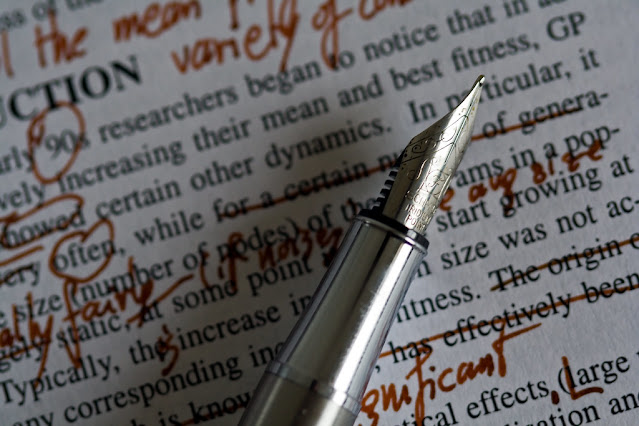
Well, the members of my in-person writers process group call my edit pen, Big Red, along the same lines of that movie — me, as the sheriff, and my pen that big old bat... lol... 

Of course, they know I'm not brutal or scary, but they've come to realize I'm passionate about making their pieces the very best they can be. I already KNOW they're all extremely talented. That has never been in question. The goal with those edits is NOT to demean, but to make their already wonderful works shine.

Where did I get my passion, you ask? From instructors who did the exact same for me.

A writer never learns, never evolves, from their successes. Advancement in one's métier comes from their highlighted mistakes, and through a figurative truckload of them over the years, I've learned to play a mind game with myself — the Red Pen Game.

After a work is finished — drafts, Read Out Loud, betas, rewrites — I ASSUME there ARE mistakes a plenty in that final draft. 

The Game: with the help of an editor, let's see how many we can find and annihilate! It's like a game of Battleship, where the author is unaware of his enemy's location, so the player needs help in finding and firing off those torpedoes to down those errant suckers!

The Key: by ASSUMING my work is flawed right from the start, I've taken the pressure off myself to be perfect to others. And with every flaw found, and corrected, it's like the downing of an enemy battleship, slaying each foe, inevitably advancing my artistic skill. 

I literally LOOK FORWARD to error location in my works from others! No, seriously!

I'm confident in my own skill as a wordsmith, but I know I am nowhere near perfect, and I need others to uncover what I myself cannot see, now, and for the rest of my artistic life.

Fear of Critique stems from a writer having little self-confidence in their own skill — again, the psychological. Are you getting now why I say writing is 90%  a mind game?

  • New writers shouldn't be self-conscious about their ability. 
  • New writers should feel empowered by their passion and eager to become a learning sponge, soaking up as much knowledge as possible about the literary arts, from every mentor who comes their way.

As long as the red pen critiques are,

  • specific to a certain flaw  - story development, line/style consistency, proofing
  • not a sweeping criticism or a blatant attack in terms of taste, or co-writer jealousy

Then welcome them with open arms, smile at their happenstance, rewrite, and learn to not make the same mistake again.

And above all, ask WHY? 

You need to know why a sentence or scene doesn't work to know why being delivered a different way does, so that you can internalize that error, and never make the same mistake again. 

Warning: If you gloss over these edits, you're not internalizing the errors, and you WILL be as a serial killer, and continue to maim your works in the same way, over and over again.

The Result: once you look at edits as a game and treat them in the right way, you will never be afraid to have your works thoroughly Red Penned. And that result, right there, will have you,

  • fearing the process less
  • wanting to write more
  • making less excuses not to write.

Your STOP Not Writing dragon greatly slayed...

29 April

Fear of Being Critiqued...


New writers get their feelings hurt when someone reads their manuscript and points out the inherent flaws. They might not admit the hurt, but it's there...
 
It amazes me why writers should be any different from any other apprentice in any other métier.
 
If a beginner pianist gets a note wrong in the song they are playing, everybody listening — including the pianist — knows they made a mistake.
They accept the pianist needs more practice.
The pianist accepts they need more practice.
Nobody gets offended.
Nobody debates the issue.
The pianist gets more practice and someday soon they will perform the piece again without those flaws. Nobody has a meltdown about it.
 
Then WHY do beginner writers not accept this fact?
Because writing is broken down like this:
20% skill
9% imagination
1% luck
70% psychological.
 
Yes, my furry wittle writers... the greatest percentage of successful writing is to surmount the psychological.
 
It will happen, but not without extreme amounts of practice, completing many types and lengths of works on many subjects with many styles of delivery utilized, and ALL ably critiqued.
 
No, my pretties, it doesn't happen because you own a pen and some paper or a laptop, and you happen to have a thought in your head.
I'll repeat that: It doesn't happen because you own a pen and some paper or a laptop, and you happen to have a thought in your head.
 
The fear of critique disintegrates the moment you accept this fact.
You are freed from any Ego you are petting right now inside your head.
You accept you ARE an apprentice.
You accept you WILL make mistakes.
You acknowledge it's your craft that needs work, NOT your person.
 
So, what does this awareness do for you? 
You no longer feel afraid of submitting your manuscripts to others for assessment. 
 
Note: by "others" I mean learned souls when it comes to the mechanics of writing - plot/character development, style consistency, grammar/proofing.
And no, your mother doesn't count as a learned soul unless she's an English or Creative Writing university prof, and can distance herself from being your mom (likely not).
 
From this point forward, you EXPECT to get your manuscript back with as much red pen ink on it as the original black. And when you do, you LEARN from those corrections.
You don't ignore them.
You don't avoid them.
You don't gloss over them.
You own and internalize them, and take them as GIFTS, never making those same mistakes again.
 
Example in Point: I once typed the word, "shinny" instead of "shiny" in a manuscript. Word confusions like this are tricky to locate by a writer, but, of course, my beta reader easily caught it, and chuckled! And I laughed too, feeling like a 4-square idiot! Well, let me tell you, a month doesn't go by that I don't read either of those words or attempt to use those words that my past gaffe doesn't spring to mind, and I smile. And that mistake happened YEARS ago!
 
If the reader hadn't pointed that error out to me, how would I have known to be more careful in searching for similarly spelled word sets? That critique became a lifelong gift!
 
After many years of writing manuscripts with words written into the multi-millions, I no longer fear critique.
I expect it.
I welcome it.
And if someone who reads my MSs doesn't have anything critical to say, then I get suspicious, and look even harder for the gaffes I KNOW are there.
 
And as new writers, so should you!
 
Remember what I said: writing is mostly a psychological endeavor. The sooner you get over yourself and let your Ego take a flying leap, the sooner your craft will improve.
 
Reality Check: You will be correcting your works and learning this craft for the rest of your life. There are no perfect writers. Ask any master pianist.

15 April

The Literary Learning Curve...


The Literary Learning Curve...
Ever consider you're riding that wave backwards?
 
Most new artists slowly, fearfully, creep UP the curve.
They start with some topic and some form that they are,
a) comfortable with,
b) somewhat knowledgeable about.
 
And so with every work completed, small or large, they get critiqued heavily on what they "thought" they knew they could handle competently, so the assessment burns their butt, and they often skulk away quietly, drop their assignment on the floor of life, and melt away, never to create again.
 
Does that sound like every writer we have ever known, in the entire universe of writers?
 
Consider doing things backwards.
Backwards for me has been a lifelong penchant.
I'm told I even break eggs backwards.
 
What I'm trying to get at here, is stop attempting what is comfortable and pick a writing assignment that is,
a) completely uncomfortable,
b) completely out of your wheelhouse,
c) demands far greater skill than you possess right now in order to competently complete the work.
 
I know, you say, "But if I keep crapping out at easier stuff..."
I say in retort, "Okay, how 'bout we get you crapping out at really hard stuff instead? 
 
Crapping out is crapping out, isn't it? Do you want to be caught as a cat burglar trying to swipe a cubic zirconia kid's bracelet OR the Hope Diamond?"
 
While I rot in jail, I'd rather have remembrances of the Hope Diamond I got within 5 feet of nabbing just before that damn cop sprayed my eyes with tear gas. Ahh...good times...
 
The Gist: if you attempt an out-of-your-comfy-box work that demands higher intellect, focus, determination, and you submit for critique, and with all the Red Pen boo-boo marks, you re-write, re-submit, and re-write and resubmit again, until your mentor deems the work "competent" — not great, just satisfactory — that will put your skill level on a far higher echelon, quicker, than if you just crawled up the comfy literary ladder.
 
Then, after that difficult toil, return to your comfort work.
 
Now, do you see the difference in your skill level?
Now, do you see blatant errors in your prose, you never saw before??
Now, is your imagination far richer for plot ideas, character motivations, dialogue sincerity???
 
Take my advice. Stop writing in your comfort zone.
 
Stop writing a memoir about yourself. I know that's what you're secretly doing, hiding the rumpled pages under your bed or way back in your desk drawer.
 
Start a difficult piece, preferably short, and fart and grunt and groan your way through it. Hate it with every word choice and every sentence completed. Curse tons. But do it and complete it, and submit it to a mentor for critique. And re-write that sucker until your mentor stops dry-heaving.
 
You will get back a paper full of red pen marks.
You will have failed miserably.
But you will learn to accept failure far easily, you will admit to your faults, admit you need to learn and practice more, and you will readily sit down and re-write and re-write until that failure isn't a failure any longer.
 
Afterwards, your previous comfort level works will be a piece of literary cake to easily gobble. 
 
Trust me. Follow me. I know it works. It will get you from not writing TO writing, now, and consistently in the future. You will have Red Penned your mind as well as that difficult piece. Writing is 99% psychological, peeps, whether you want to accept that fact.
 
FYI: I'm currently writing a 9-stanza poem about Bob Dylan. I've never been a fan of poetry, and in the '60s I thought the wee dude needed a bath and a comb. Difficult much? ;-)