Showing posts with label STOP Not Writing. Show all posts

09 June

Writer Fatique - From Stress, Fear, or is it Real?


It happens to all writers...that all-encompassing exhaustion...

It can happen after an especially hectic work week, where severe focus was needed on deadline pieces.

Or it can sneak up on you when you least expect it.

But how can you tell if it's real or emotionally driven?

I will bleed out before I'll miss a deadline, so for me the constant war against body stress is real, and it will often mask as severe fatigue. It's my psyche's need to check out from reality for a while to lower the stress, which is not conducive to meeting the new deadlines before me.

I've also sensed a weariness if I'm facing a new book project, but I know there's a distinct possibility it's solely from Fear of the Unknown. You'd think after writing six books, I'd be past this mind game, but here's the kicker, my fellow furry scribes: a writer is never past this mind game. All an experienced writer can do is better judge the type and degree of exhaustion they are experiencing.

Here's what I do to gauge if it's Stress or Fear or Real:

When I'm about to close the laptop and take a nap because I think I can't plunk down another word, I set a 15-minute timer, and keep writing on anything for those 15 minutes. If after the timer goes off, and I'm in a writer flow, not wanting to quit, I know it was from the Fear of the Unknown, aka Writer Stage Fright, and I continue to write on.

If during those 15 minutes, every word typed, although each is a good choice, is like trudging through Flanders Field mud, then I know it's from Stress, of working too long under too many deadlines. The Solution: I'll take a short walk outside to reinvigorate my mind and body or take a cat nap to see if, afterwards, I'm refreshed enough to continue writing for the day. 90% of the time, that break will help, and I'll finish the work day.

If during those 15 minutes writing, my brain simply cannot come up with the right words like it normally would, then I know it's exhausted for real, and I need to wave the white flag for the day and rest, as an investment for a more productive tomorrow, and to ward off Burn Out, a very real writer disability that can take far longer from which to recover. A full time writer must avoid Burn Out at all costs.

There is a fourth option, too, and that can be hunger and/or thirst. And I do NOT mean the empty calorie snacks you slovenly gobble at your desk. 

To discover if your body is lacking nutrients, take the Two-Step Challenge:

First, try drinking a full glass of water, and after a short break, try again to write. If you feel more alert, your body was likely dehydrated. 

If the water didn't work, 

Second, ask yourself when you last ate a decent meal. 

Did you miss breakfast? Eating a decent amount of protein to rev up your day.

Did a writing session go overtime, and you forgot to eat lunch? 

Did you have a decent dinner last night? (And by decent, I mean fresh vegetables, a small portion of lean meat and maybe fresh fruit for dessert.) 

If food is the issue, after you break for a meal, your mind focus will reignite very quickly, or that's been my experience. The same with water, if you're dehydrated. 

Note: feeling hungry is often just a sign you're dehydrated, so instead of automatically ingesting calories, try first drinking water.

A full time writer has to gauge carefully the symptom of exhaustion and respond accordingly. If you do this, over time, you'll experience fewer bouts of debilitating fatigue, as you'll learn to recognize the symptom, quickly gauge its cause, and course-correct before it hinders your work day.

Writing is a psychological endeavor, yes, but it's also a very physical activity, too, even if your body is merely sitting down. It takes a lot of mind/body juice to work with words. If you don't heed the fatigue, and know how to treat it, that book you want to finish, no matter your skill, simply won't get done.

08 June

Can't Write Your Own Words? Then Type Out Other's...


There is nothing wrong with copying. It's sometimes the best way to become unique.

Many of our greats have done it — I mean sitting down and typing out works written by your literary idol.

Hunter S. Thompson typed out F. Scott Fitzgerald. 

Hunter said F. Scott wrote about life from inside the rarefied world, while Hunter said he wanted to do something similar... by smashing the window panes, breaking and entering into that rarefied world. Possibly the difference between living on the right side versus the wrong side of the tracks, so to speak. But you'll notice both authors from both sides made permanent societal dents.

[A Side Tangent: I absolutely HATE when writing conference panelists say, "Everything has already been written, so don't try to think your works will be something brand new, just a new version of the old." I always wonder why in the flying feathery hell they feel the need to say this, even if it's true? Such defeatism, even if valid, defeats the new writer psyche. I realize their intent, but I think the writing world can be so cruel to new writers sometimes. It's no wonder, so many literary artists give up the ghost too soon. I believe the writing world, like no other artistic community, is rife with self-conscious, jealous souls...]

Tangent over. Now, back to the story...

Hunter adored F. Scott's style, and in his early writing days, he wanted to emulate that style, so the best way he knew how was to type out the celebrated author's published works. And over time, that rudimentary practice had Hunter finding his own voice in typing out F. Scott's word choice, scene set-ups, and emotionally driven, symbolic visuals. 

In copying Fitz, Hunter didn't actually copy Fitz. He discovered himself.

Many new writers have great difficulty finding their own voice, and that can lead to a stagnation in their writing process. How does one speak if you haven't a voice? you ask. And I say, "Exactly."

Many new writers, as I've previously said, are inherently shy people, so it can be they haven't much of an outstanding voice in their everyday lives, so how would they have a voice on paper?

I never personally met Hunter Thompson, but he struck me as a typical introvert who needed that alcoholic/drug fix to be less of an introvert, which, of course, was his downfall in the end. But it shows to me, he needed help with his literary voice, too.

If you see yourself this way, you're in good company. So many literary greats have copied down so many literary greats when being introverted in the beginning of their career hindered their success.

HOMEWORK: On the days you simply cannot find the courage to write down your own words, let this not stop you from showing up and doing the work! Instead, copy. Type or hand write your literary idol's works — a few sentences, a paragraph, a whole chapter, and for as long as it takes you to comfortably start writing words on your own. In so doing, you'll sense the flow of that author — in the timing, suspense, foreshadowing, symbolic placement, in atmosphere creation, in the author's courage to say their truth as you will undoubtedly do one day. Typing out the works of the greats is a great start down your own artistic path.

Showing up to work can take many forms. As long as you are working the words, your brain is maturing as a scribe. It's when you sit there on your couch and do nothing but ruminate that you are literally doing nothing to advance as an artist.

[As to that panelist who says everything has already been written: always be ready as an artist to break any universal truth... ;-)]

07 June

Developing Your Creative Ear...


Photo, A Poetic and Powerful Life

Success on this earth sadly coincides with that wives tale your mother told you as a wee tot...

"Practice makes perfect."

I seriously would like to punch out the first wife who uttered that truism, not because she was wrong, but because she was right, as every time I hear it, well, punching something springs to my frustrated mind.

Hey, I never said I was perfect.

As that first wife rightfully knew, in any endeavor, practice is what's needed for the apprentice. Tons and tons, truck loads, even. I don't care if you weld metal things, do wood joinery, or, say, weirdly enough, want to finish writing a book. That damn adage pops up and splashes righteous goo in your face that CANNOT be washed off. Crikey! So annoying...

But here's what happens when you DO practice writing, every day, and for the rest of your life: 

Over time, you develop what experienced wordsmiths call the Creative Ear. And this skill ONLY develops while a writer writes. Not when he's waxing poetic smack in front of hangers-on at some high-brow cocktail lounge... (Okay, that last visual may have been too specific, and too me. Again, I'm not perfect.)

The Creative Ear is the ability to better, easier, hone-in on the best writing ideas, the best phraseology, the best literary delivery for any piece. And the more you write, the better that intuitive skill develops, and the less post-draft editing crying jags you'll have to endure.

[An Aside: This is the main reason why I'm so against the "pantser" writing mentality — the post-draft edits. I'm of Northern-Irish descent, and we Irishmen are inherently lazy. (Stop throwing rotten tomatoes and let me finish, my fellow Pot o' Golders!) What I mean to say is that we do NOT like to do things twice when once will suffice. It cuts into our after-hours drinking time. (Again, stop with the tomatoes!) And by twice, I mean the 30 BILLION TIMES pantsers WILL have to rewrite sentences, reshape the plot line, reformat character personality traits/motivation in their schizophrenic, airy-fairy first draft attempt because they had no pre-determined parameters. Why a person desires to get lost in a forest and die of hypothermia, and his emaciated corpse be nibbled on by centipedes when a perfectly good hiking path is on offer, I'll never know. Aside tangent is over. Whew! I feel better now... ;-)]

Back to the Creative Ear...

When a writer does not regularly start, work on and finish sentences, paragraphs, chapters, stories, his creative intuition for what works and what doesn't, doesn't become refined. It's like a blind man who doesn't practice walking with a stick and feeling for objects, to know what's what and where things belong. That Second Sense skill must be worked on to be enhanced.

With new writers, they aren't capable of intuitively sensing when a sentence or phrase or chapter arc has been best achieved, if they haven't failed and succeeded many, many times in the attempt. 

This literary "blindness" I have often demonstrated, not by teaching, but by showing. This is not something I like to do, as I never want to stain my way onto another artist, but the Creative Ear is not a tangible entity, a normal material skill. I can tell new writers over and over again what makes a good sentence, a good scene. They will nod in agreement, but still not deliver the goods in their own works. Their sentences, scenes will be wordy, convoluted, until I simply take one of their sentences or paragraphs, and rewrite it, and show them the difference. Then, I'll get,

"Oh, that's way better! Why didn't I see that way of writing it before?"

It's simply the development of the Creative Ear that gets a writer from apprentice to master, from a blind man who is lost to finally "seeing" the way. And other than constant practice, that ability will not mature, and a world of edit hurt will remain in that writer's future.

No one is born having a fully-developed Creative Ear. Yes, there can be those >1% prodigies, but I assure you, you and I are not one. The Creative Ear cannot be taught. A person can be taught grammatical rules, form and function, but that intuitive sense is simply:

God-given artistic/creative slant + constant and unending practice = literary success, the ability to sense a well-crafted work.

[Another Aside: people who scoff at writers who edit a passage as they write the first draft haven't a clue as to what a mature Creative Ear can achieve in this instance. Such a skilled wordsmith isn't watering down the first draft passion; more so, he's seeing immediately how that draft can be worded as he writes, eliminating a huge percentage of edit rewrites at draft end. This isn't talked about much by writers who use this method because they know it's not industry accepted. But if you do a search, you will find well-celebrated similar method authors, who have far fewer meltdowns come the editing phase. Second aside tangent over and out.]

Your Creative Ear.

Accept that it exists in you right now, but that it needs severe practice to mature.

Every day. In attempts which fail, and succeed.

Not ruminating...

Not entertaining your imagined muse...

Not waxing poetic with your tribe... will help.

Just the hard, slogging work of constantly throwing together words to form a cohesive and effective idea.

[Last Aside: that's another reason why I call writing, as in any learned endeavor, work, not mere fun.]

HOMEWORK: Sit thyself down, and make this Day One of further developing your Creative Ear. Write something, anything. Just write.


04 June

Crank That Old Model-T Mind - Get Your Perpetual Prose Engine Purring!

Photo Mitchell County Historical Society
 

Ford engine...body, mind, fingers...they're all the same.

If you get the old brain cranked like a Model-T Ford, and run it for a while, spitting out all the bad backfire exhaust, aka writer fears and doubt, that writer mind will happily keep on running...

This is my convoluted way of saying that once you get into a daily writing rhythm, your mind and body will happily oblige, realizing that nothing scary comes from the repeated effort, so away you do go, without a thought or a care, plunking more words down on your WIP than you've ever saw plunked down before. 

Like writer's flow where your mind is in that story bubble so strongly your fingers can't keep up, so can the same kind of flow be achieved for your daily writing sessions... once you get that old jalopy of a fearful mind chugging right along, and your creative juices are flowing like viscus oil on eight cylinders.

Okay, I have cars on my mind. I can't always defend my way of thinking. (Okay, I can rarely defend my way of thinking.)

The Key: the getting going, the cranking of the shaft, the sparking of that old, idle-too-long mind engine.

It may take you a few tries, maybe a week or so of going through the motions:

  • walking to the desk
  • opening the notebook or laptop
  • sitting down
  • gathering your scene cards
  • and beginning to plunk words down on the next scene.

There's every chance you won't like what's spewing out, initially, but don't be a perfectionist right now. We need you revving your mind and finger engine, not entering your jalopy into NASCAR.

But with every writing session completed of every day, you'll soon sense that creation automation kicking in. And when it does, don't stop it now. Don't rest on your production laurels. Now is NOT the time to skip a session to celebrate. Keep that momentum going. And the longer you do, the easier it'll be, and the more permanent the habit. As I've said in a prior post, try and keep that momentum going for 42 days. Your mind and body need time to kick that act into an automatic overdrive.

As you enter into this writing flow:

  • Don't word count. 
  • Don't word analyze.
  • Just write, one word, then another, and another...
  • Scene, after scene, after scene...

It's not about your story right now. 

It's about your mind and body being primed and pumped to reach high and sustained RPMs to keep those creative juices flowing. The story quality will come later. Let's practice the doing first. Baby steps, peeps. Baby steps. One speed bump at a time...

HOMEWORK: It's Saturday tomorrow. If you're off work, get the engine crank out, turn that sucker, ignite your mind, prime your fingers, and get your perpetual prose engine purring!

And in the comments below, let us know how your crank shaft turned over... ;-)


03 June

Who Are You Writing For?


A man and a woman — he in his late 50s, she in her mid 40s — relax in a knotty pine paneled family room. Their easy chairs  — hers, an overstuffed turquoise armchair, his, a burgundy leather rocker-recliner — placed on either side of a big picture window that looks out onto a small lake, the weeping willows and sugar maple trees which line the water's edge, their branches bending in the soft summer breeze, their leaves wafting to and fro, making a gentle clapping and a whispered swish. 

The woman nurses a glass tumbler filled with Canadian Club rye and Coke and two ice cubes, as a Belvedere cigarette smolders slowly in a glass and silver ashtray stand. 

The man, with his well-shined oxblood dress brogues resting on an ottoman, rocks imperceptibly back and forth, as he puffs on a burled walnut pipe, the smoke rings lazily rising and spreading wider into the warm air. Beside him, an old 3-legged milking stool from the farm that holds a dark amber glass ashtray and a stubby amber bottle of Labatt's 50 lager, the beer just out of the fridge, frosty and cold. 

Both sit silent. Both are listening intently...to me, as I read out loud the stories from my books. They show no obvious expressions. They are watching and listening, muted, concentrating, as ghosts often are, to me, their daughter.

There isn't a minute that goes by that my late parents aren't with me as I type. Luckily, for my first three novels, my mother was still alive. My father died a long time ago, never knowing me as the writer I am today. Both are gone now, but in my mind's eye, both sit quietly across from me, breathing in every word, every sentence I create. I write for them.

I tell you this because it's important to a writer's mindset how he or she exists in the writing flow. Whoever you are writing for, whoever that person is, they ARE important to your psyche, to your overall success as a wordsmith, especially on your down days, the ones that seem to have you beat, the ones where gravity feels a 1000%, and every move you make takes a Herculean effort. It will be that person, the one you see in your mind's eye, who will be your quiet guide, who will emotionally lighten your load, and talk to you, encouraging you to fight to write another day.

Writers have a calling, and it's not an easy one. We write for the world. We are the world's liver. We filter out all the poisonous noise and create the essence of life's precious moments as we perceive them. An utterly exhausting enterprise, and one which can weigh so heavy on the heart, sapping all strength. Without your guide, the one you're writing for, story-telling could become insurmountable.

Is this your case? 

Do you have someone you're writing for? 

If you don't have a writing cheerleader on your side, maybe you should. Or maybe you already do, and you don't even realize it.

Today, I want you to sit back and think about whom you feel as that essence around you when you write. No, I'm not being all hippie-dippy here. Everyone in this world needs a guiding hand. Maybe yours is a real mentor, alive on this earth, and with us now. Maybe yours, like mine, has passed. But I bet if you think about it, you've felt someone near you when your writing flow is at its best.

Today was a tough day for me. In Calgary, a heat wave holds the city in its grasp, and it makes even thinking, much less writing, a high obstacle. But as the day's heat subsided, I felt my parents' push. 

"Come on, Barbie, get up and get at it. You have things to do." 

And, of course, I listened to them, and smiled. And this is why this article exists now, solely because of them. I might have allowed the day to beat me, but my parents came through, encouraging me to plunk fingers down on keys to create the tiny vignette above as an example just for you.

HOMEWORK: Figure out whom you're writing for. They will be your writing saviors when nothing and no one else can help.

02 June

Narrowing Characters, Narrows Plot...


Narrowing Down Your Characters = Narrowing Down Your Plot Possibilities...
 
If you're wondering where your story is taking you — and this is why your fingers won't move on the keys — consider this exercise:
 
Take each main character and make a list of what they will DO and NOT DO, according to their personality and motivation.
 
That will highlight the finite possible plot points to your tale.
 
Again, this is yet another reason WHY I do NOT espouse being a panster. 
You NEED TO KNOW before your fingers go!
 
Knowing what can't work is as important as what can in a book. That will keep your story on a reasonable trajectory, and often limit or remove those plot corners you could have painted yourself into had you not known, and plunked fingers on keys, regardless.
 
And again, this is another reason why it's SO important to take months, at least, getting to know your characters. Could you meet someone at a cocktail party, grab their hand, and know what they would do after you left the room? Hardly. Don't think it's any different for characters.
 
Whittle down your characters' options - likes, dislikes, needs, wants.
See who aligns with whom.
See who repels who.
 
You might color in your story's plot black holes just by this simple act.

01 June

Your First Finished Book!


Your First Finished Book!
Holy cow! How thrilling!
 
You finished the draft.
You've self-edited, ROLing - Reading Out Loud - at least once.
You've had the appropriate beta readers go through it, and you've made the necessary corrections.
Now, you're jonesing to have it be read by all the world!
 
WRONG!
 
Remember. It's your FIRST book, not your 7th or 20th or 200th.
It will never be the book that will display your best writing skill. 
 
Yes, it will be good, if you've done all the steps I mentioned above, but unless you've paid a professional editor to go over it before self-publishing, or your draft has been picked up by a publishing acquisition editor (both avenues will have you up to your neck in editorial rewrites, guaranteed), it most likely has developmental and/or line and/or mechanical gaffes every first book has.
 
Yes, by all means, put it out there — self-publish or promote it on a small scale — but don't go nuclear in your promotions.
 
You NEED independent reader feedback at this point to highlight those gaffes that weren't evident in your prior editorial efforts, so you have time to correct that manuscript before the world gobbles it up.
 
This is NOT a downer I'm expressing here.
It's a cautionary tale in the self-preservation of your author Image.
 
I read almost daily of new writers going on social media and shouting from that virtual mega-phone of their first book, and its instant availability to all 'n' sundry... and likewise, I quietly shiver, fairly well knowing what those first few book reviews may look like.
 
No, they won't be all bad.
But those who aren't linked to you in any way will NOT give you vacuous glowing reviews like your friends, colleagues and family might, or others who read it and never absorbed it, glossing over the gaffes.
 
Be proud of your achievement. hell, yes!
 
But don't let your excitement cloud your business sense.
 
You want your good author name to last for an eternity.
So, take it slow, and be careful with what you add to create that good name.

28 May

Writing vs Promoting - New Writer Ratio...


New Writer Activity Ratio: 95% Writing/5% Promoting... or, at least, it should be.
 
New writers get caught up in the social media Group Think/Peer Pressure cauldron, thinking the way to literary success is doing everything else BUT writing.
 
That's like a beginner pianist dusting the piano, sorting the sheet music, adjusting the bench, and not laying fingers on the keys, practicing playing the songs.
 
Are you chuckling now, rather red-faced, secretly relating to this go-nowhere-fast pattern? 
 
As in all things in life, don't put the cart before the horse. Evading hard work doesn't make that work disappear. It just prolongs the agony. Seriously. Rip the band-aid off quick.
 
You. Need. To. Write.
 
That is the ONLY WAY you will actually succeed as a writer, to graduate from new > to experienced > to skilled > to master.
 
There are a million words you haven't written down yet that you need to in order to gain the skill to write competent, lyrical passages that will deeply affect your reader. 
And no, social media blurbs do not count.
 
Social media promotion/exposure has its place, and is beneficial...AFTER you have something to promote and expose.
 
What do you think is the ratio between new writers who TALK about writing and those who actually WRITE? Refer back to the Writing ratio at the start of this post to give you a hint... ;-)
 
Yes, on your free time NOT designated to write, you can...
1) set up a FREE author website - do NOT pay out money where you haven't earned any yet, peeps.
2) register on your top 2-3 social media sites - an author page, NOT your personal page, and you can post pieces on your experience as a new writer, NOT personal junk.
3) attend writer conferences and take copious notes in seminars covering literary topics of which you need more knowledge.
 
But NONE of those three activities above should EVER steal one minute away from your writing sessions. Not. One. Minute.
 
HOMEWORK: if you haven't already done so, get serious today, and put together a weekly or monthly writing session schedule aligned with your ideal writing times you uncovered in your 2-week activity diary I told you to previously complete, to find those key times when you're awake, healthy, and free of job and domestic responsibilities, which might mean stealing some time away from your Goof Off hours, and there are many — TV, video games, naval-gazing, etc.
 
If you're only reading me and not actually setting up a proactive system to write, you're doing yourself and that unfinished book no earthly good.
 
Until that first book is finished,
95% write
5% everything else
 
As a new writer, there is NO other doable ratio to literary success.

27 May

Take a Writer Learning Day...


Every once in a while, a writer needs a learning day, whereby they shed their writing/editing To-Do list and spend that session learning new things. Those things could be industry-driven or further research for their WIP.
 
The Key: Is letting your subconscious work behind the scenes on that WIP while you up your knowledge in some literary area.
 
When: Do NOT schedule these days. Let them spring themselves on you. Maybe you received an industry newsletter which had a plethora of linked articles you should devour, or an aspect of your WIP demands in-depth analysis of some kind.
 
Hint: Allow your writer's instinct to twig to this moment. Maybe it's when your industry reading pile overflows or when your plot/character(s) can't move forward without more research-driven acquired knowledge.
 
And above all, do NOT feel guilty of these days. If they only happen once in a while, that's not time stolen from your book. It is crucial information gleaned, which will propel your overall knowledge and make everything therein produced that much richer, and doing so may lessen your writer's block, as now your brain has what it needs to create. 
 
Our brains tell us stuff if we're open to listening, you know.
 
Are there articles out there you've been ignoring?
Webinars?
White papers?
Reference books?
Maybe today is your Learning Day.
 
Mine was yesterday.
Have at'er and get'er done!

26 May

Break Your Own Writer Rules...


Today, I want you to pretend that everything you "think" is correct about your beliefs as a writer is WRONG.
Yes, you read me right.
 
Pretend that if you are a devout believer in the Oxford Comma, today, you're not.
Pretend that if you believe in the 3-Act story, today, you won't.
Pretend that if you believe you can't write anything today, you CAN.
 
Now, don't argue with me. My fingers are in my ears, and I'm humming the theme song to the TV show, M*A*S*H, so I won't hear you anyways...
 
Today, DECIDE to be WRONG about all your pre-conceived writing notions.
Remember: Agatha Christie broke the cardinal murder mystery rule, creating an unreliable narrator in The Murder of Roger Ackroyd.
 
Writing IS ART.
Yes, there are rules.
Yes, you have to be skilled enough to know when to abide by them and when to break them.
 
But today, we are going to force you to think differently about yourself and your writing capability.
 
HOMEWORK: make a LIST of all the things you believe writing is, for you, then make a second list of how you could be wrong about ALL those beliefs, and an example of how you'd break your own "rules."
I need you to be more FLEXIBLE as an artist.
 
The fact that I know you're a) not writing at all, or b) can't finish that book is because c) you're too rigid in your own beliefs, and d) you're new to this writing world, so you probably are mistaken in many of those beliefs.
 
I said, don't argue...*fingers in ears, humming M*A*S*H...* I can, too, hit the high C at the end. Just listen! :-P
 
Okay, now go do this exercise.
I know you guys are out there, even if you're silent like the grave.
 
You're not commenting because you're scared of me, right?
I can appreciate that. 
 
Now, go off, quietly, and complete this exercise, and if you sneak back later, when I'm not here, to tell the others how this mind-blowing exercise went for you, I promise I won't eavesdrop.
 
And I won't hit you either... probably. :-)

25 May

Plot, Character Passion - How Long Can the Love Story Last?


Plot/Character Passion... How Long Can the Love Story Last?
It had better be months, if not years, my fellow scribes, for a book-length work takes a long time to create. The story and its characters... can you sustain the passion you have for both for however long it takes?
 
Odds of Long Term Literary Relationship Success: most new writers I've run across have no conscious idea of how immersed/dedicated you need to be with both in order to finish a book. 
 
To new writers, their story and the people in it, well, they fall in love at first sight, like you would with some handsome guy you barely know. And the two of you rush off to Vegas to get hitched. And after the honeymoon phase wears off, you guys can't return fast enough to Vegas to get a quickie divorce, aka, the new writer dropping that unfinished manuscript like it's a hot, infected potato, and shoves it into the back of their desk drawer, never to see the light again.
 
Grrreat...just peachy........
Are we still having fun?
 
Moral of this Pathetic Story: don't jump at the next shiny idea that hits your periphery. Think long and hard about it. Can it, and you, sustain the passion for the time it takes to flesh that pal out into a long work? Can you two endure the months of frustrating research before one word hits the page? Can you live through the bad drafts and the rewrites and the problematic scenes and sentences that take forever to get right, and even then, go to your editor smelling like poo?
 
Did I mention writing a book is work?
 
Hint: pick a story idea that has been with you for many years. All of my book-length pieces have been traumatic events or societal mysteries that have tumbled around in my head for decades, so without one word written, those happenings and the people they affected have always been there, in my subconscious, waiting for the right time to be chosen as books.
 
Note: that's not to say new ideas don't have lasting power. It's just ideas that you've already lived with for quite some time have become quiet loves, haven't they? Not some flash in the pan momentary passion.
 
The Plot: study it. Ensure it has lasting tension, story power, for 300 pages.
The Characters: have you fully rounded them out? Have you lived with them long enough so you guys CAN endure the mundane months/years ahead? In good writing times and in bad? And yes, my peeps, this book will be a marriage, for better, for worse, in more poverty than wealth. How dedicated are you to this relationship?
 
My Advice: keep a running notebook of all those shiny, new ideas, but think long and hard about the ones you "think" could make a book. If the passion dies, so will the piece. And a new writer holds enough doubt in their head. They don't need to pile on.
 
Spoiler Alert: In the movie, Love Story, Ally McGraw croaks, so Ryan O'Neal doesn't have time to get sick of her bratty ways... ;-)

24 May

Writing Every Day - A Truism Accepted...


A writing truism I could no longer have a hissy fit about, and neither can you – writing every day…
 
Nope. Don't X me out.
Slowly back your fingers away from that mouse or touchpad.
Stop with your "talk to the hand" hissy fit, and read me.
 
Once upon a time, I WAS YOU.
I thought this "truism" was a load of animal poo-poo.
I went YEARS not accepting this adage tripe.
Problem was, I was wrong. 
 
You must know, it's damn hard for me to acknowledge the error of my ways, as I think I'm quite "special." *patting myself softly on the head, and yelling to the asylum nurse, "Where’s my Thorazine!"*;-)
 
Thus, I will explain…
 
Many writers conferences ago, I befriended a rough-round-the-edges celebrated Scottish-Canadian scribe, whose blue pencil group session I attended. He said a lot of realistic, practical things, but the one thing which stuck in my brain was him simply stating, "You have to show up for work" to achieve literary success. He declared that if you plan on becoming a serious writer, you have to wake each day, get dressed and go to work, aka WRITE, and adopt a work-ethic expected in any other full time job.
 
If you take seriously this métier...
If you truly want to start and FINISH your book...
If you want to go from hobbyist writer to master wordsmith with many quality works under your name…
Then, there is no other way.
 
I don't care if you're the smartest nut in the nut barrel, and you ooze prodigy slime... if you do not practice every work day like you would in any other endeavor where you hoped to succeed, then you are full of animal poo-poo like I once was, and you won’t get where you want to go with your writing.
 
You can attend all the conferences you want.
You can belong to a plethora of writers groups.
You can talk smack on the process and wax purple prose pathetic on your WIP, but unless you put your money where your mouth is, unless you lay rubber on the road, unless you freakin' sit down, open up that file and smack down and/or edit words on that WIP Every Single Day, you,
a) won't finish that WIP
b) won't write well on that WIP
c) and you won't go on to finish other works well either.
A. Simple. Unavoidable. Fact.
 
Yes, just like with any other career, you must take off 2 weekend days. Your mind needs to rest, and to subconsciously churn literary milk into cream on that WIP. But during your writing work week, you show up for work. NO excuses.
 
Annnd yes... to train yourself to do this...can be like shoving bamboo shoots under your finger nails. You will grunt, and groan and curse and fail, and start again, and hate this process for the 6 straight WEEKS it will take you to adopt this new habit.
Yes, you read me right. 6 weeks. 42 days of constant showing up to "work."
Why? Because humans are not that smart. It takes that amount of time to have our minds and bodies acclimate, and automatically act upon, a new task. Don’t believe me? Look it up, naysayers…
 
And how do I know this will work?
Because I did it. I suffered through those 42 days. I screwed up three times, started over three times, and finally wrote for 42 days straight.
And I suffered through this torture because I inherently knew that celebrated writer was right.
 
It's been no different in the other skills I've previously adopted.
Why should life be any cushier in becoming a wordsmith?
Why do new writers who want to become master writers think learning this skill will be easy, and packed full of yummy cake and icing fun?
That mistaken belief continues to blow my mind.
 
In my life as a competitive swimmer,
I had to swim endless laps to execute strokes, faster, many hours after the other leisure swimmers got to go home.
As a grade school football player,
I had to re-run plays as the quarterback until those plays became automatic, if I wanted to win a game.
As a student pianist,
I had to play piano scales 'til I bored myself silly to memorize the proper fingering and to learn the different notes to easily play songs.
And I had to do the same in choir.
 
And undoubtedly YOU have had to do the same in the skills you've already learned.
 
That thing mothers constantly spout to kids when they're trying to learn a new skill..., "Practice makes perfect." Well, I'll be damned, if they weren't right.
Frig! Why do mothers always have to be right!
 
So, once I finally came out of my writing every day tantrum and realized the necessity of this rule in all acquired skills, I decided to mature-up and take up the challenge, and write for 42 days straight. 
 
1) I set up a calendar sheet with 42 days. I tacked it up next to my writing spot.
2) I checked off each day after I wrote, and at the end of each week, I gave myself a sticker. (Yes, I've never tired from acquiring achievement stars like we all got in grade school. Hey, stop snickering... it takes very little for me to feel "special.")
3) And at the end of the 42 days, I got a really SPECIAL sticker... and a few celebratory cocktails... your treat can be whatever you wish. I'm a kid at heart, and of North Irish descent, so you can see where my drooling lies...
 
Let me tell you.
It was not easy.
I'm not going to be like so many article writers out there, sugar-coating this process, and blow smoke up your butt.
It's no cakewalk, but it CAN BE DONE.
I did it.
 
I knew all I had to do was open up my laptop, and on my bad days, just type the single word, "the."
That would count as writing because I had gone through the motions of...
a) going to my writing spot
b) opening up my laptop
c) opening up a word processing page
d) typing the word, "the"
e) saving my “work.”
f) closing my laptop
g) and leaving my writing spot for that day.
And on the good days, of course, I wrote a lot more. You will, too.
 
The Key: It's the MENTAL PROCESS you need to undergo, and through it, the taming of your FEAR of writing. There is no other earthly way to achieve said than to undertake this challenge.
 
After those 42 days, well, my brain transformed!
It simply got used to the process, and in turn, ignored the fear.
 
Note: the fear, that "stage fright," will never go away.
It's part of being an artist of any stripe.
It WILL be with you until the day you die.
 
BUT your mind and body will learn to write THROUGH THE FEAR.
You will no longer put off the act of writing.
You will no longer say to yourself, "I'm too tired, I don't feel well, I'm too busy, I have others things to do."
 
And what happens after that happens?
You go from an erratic, so-so writer to a prolific, skilled writer pretty darn fast!
Faster than I ever thought possible.
And with your noticeable improvement, your DESIRE to write every day grows, too!
Now, it's a positive loop.
Now, it's a self-fulfilling prophecy.
You've killed the excuses and put that stage fright in its place.
And you're on your way, every day, to higher and higher quality, and quantity, output.
And from that moment on, you can truly call yourself a writer.
You know why?
Because you actually write. Every writer work day.
That's why. 
 
You no longer just talk smack about writing.
You finally put the pedal to the metal and shed those ridiculous excuses that to be a serious scribe demands writing every work day.
 
Wake up, peeps.
Smell the coffee.
It's what you and I need to do.
 
Now, are you up for trying the challenge?
42 straight days.
No minimum word count.
Write on anything you want.
On your bad days, simply type the word, "the" and be done for the day.
On your good days, type more.
If you screw up and miss a day, start over, start back on Day One, and begin again.
 
Keep your swearing down to dull roar. I’m trying to write over here…;-)
 
If you are serious about becoming a wordsmith — and have reached the end of my rant here today — are you WILLING to try what I tried? I'll NEVER ask you to do anything I haven't already experienced. Okay? Trust me. Follow me. 
 
Comment below your experience before, during and after the challenge.
 
I'm here. I get you.
We are all on the same literary ladder.
We're just hanging by our bloody finger nails to different rungs.
 
Now.......GO!
Let's DO this.

21 May

Scheduling Escape - Feed the Writer Soul...


Those of you who've never met me in person have no idea that when I'm in work-mode, I channel a mélange of General Patton and General MacArthur. Yes, I'm a brazen battleaxe.
In university, if you bothered me while I was cramming, I'd chase you down the Rez hall with a used curling broom... no, not the soft ones you see today, the witch-on-broom itchy, scratchy, hard-as-heck type broom. My first year on Rez, I was humorously awarded the Miss Congeniality prize for my floor. Yep, I'm a keeper!
 
But even I knew when I had to vent steam... I'd play as hard as I worked... 
 
On my second year on Rez, my floor mates laid a pillow at the side door, and tacked a sign above, "Don't remove. Barbie's Pass Out Pillow." It got regular use. One night, while hosed, I couldn't find my way to the Dining Hall - I figured eating something might be wise - so my totally blind floor mate guided me there. Yes. It took a blind girl to guide me to nourishment. 
 
Did I mention I'm of North Irish descent and can't hold my liquor?
Yeppers, still a keeper!
 
Those pathetic visuals above are to demonstrate that even a hard worker needs to escape now and then. No, I didn't become an alcoholic, but I may play one on TV.  :-) 
Disclaimer: don't do what I did. Baaad. Seriously baaad. 
 
But...
Plan your escape. 
Hopefully with far less embarrassing results than I experienced in the '80s.
 
Take an evening and decide it'll be for pure escape, to not consciously think on your WIP - Work in Progress - but to laugh and play, and just gleefully be.
 
During the pandemic, for me, it's been Thursday night comedy TV shows, one after another, eliciting non-stop giggles. My regular TV time usually involves heavy subjects on history and politics and war. But not on Thursdays. That's chuckle night... free of guilt, joyfully spent, because I know I've earned it. I've stuck to my writing schedule all work week, and have definitely earned a break.
 
Escaping without earning an escape is fraught with guilt. You won't realize it as you run away and have fun, but when the fun ends, that escape will turn out to be a negative experience, which will leave you feeling more writer-despondent than when you began. 
 
ALWAYS EARN YOUR ESCAPE. 
 
So, in your present struggle to write, don't forget to vent the stress steam.
Do it in moderation.
Do it for one night a week.
Do it for the sheer fun of it. 
 
Let your sub-conscious ruminate on your WIP. Your writer soul will thank you.
 
P.S. No, I have no idea where my curling broom and my pass-out pillow ended up. They may be displayed in the Smithsonian museum, on the Dastardly Drunkards Disaster floor. ;-)

20 May

Head-Butting Writer Fear...


I have this "thing" about spiders... I mean, I don't go catatonic or anything when I see one, and I can scoop a household invader into a plastic container and throw it outside to live a free and glorious life, but its hairy legs and mine should never meet if I want to stay out of an asylum...
 
So one day, I thought, you know, I should get over this "thing." I should face my fear head-on, or as best as could be mustered, and then I could be One with the creepy-crawlies. Long story, short, I took a guided tour through the Venezuelan jungle to meet up with those foot-long diameter Green-Bottle Blue tarantulas they have down there, where the guides use smoke to have them fall from the trees into big metal pans. Sad tale: the tour I picked went to an area they didn't inhabit, but I did get to see a 14-foot termite mound! Gad, I was itchy for days, just thinking about it!
 
Anyhoo, my pathetic point here is, don't flee from your fears and weaknesses. Endeavor to meet them head-on, and force yourself over and over to take on that fearful "thing" a) you know you're not good at, in fact, you suck it; and b) is your worst fear, your worst weakness, so if you eventually get comfortable with that "thing," everything less fearful than that will seem a complete cinch!
 
I know what you're thinking. You're thinking, "Okay, B. J., you're nuts. The definition of Fear is to WANT to flee from said."
Yeah, yeah, I know, but consider this a game. If you finally tackle your worst fear about writing, you'll have a future of literary fearlessness! Nothing, from that point forward, will stand in your way.
 
Another example: the closest I get to sci-fi anything is watching Star Trek (Star Wars bores the heck out of me. Yeah, yeah, stop throwing rotten tomatoes at me, I'll just keep ducking), and I do NOT write sci-fi. Ever. Never. Like Never-Ever. So, I purposely decided to enter a writers contest where I was forced to write a sci-fi short story. Holy heck! Okay, now I'm sweating bricks! But once I stopped hyperventilating, and with major fingers-to-keyboard grunts and groans only a tennis player could appreciate, I ground out a tale, had a sci-fi-liking beta reader peruse it for the gaffes therein, and I submitted it... never to win, of course.
 
BUT my hesitancy on writing sci-fi basically dissolved. If I ever had to do it again, a lot of my former doubts were already washed away with that first scary attempt. I learned from my sci-fi beta reader some formation points about the genre, and in the attempt I grew as a wordsmith, returning to my preferred writing realm with far more confidence in my capabilities.
 
HOMEWORK: Write down your greatest weakness in writing, and decide to tackle it head-on, to drown that fear. Repeat the attempts until you've put that weakness in your rear-view mirror. 
 
NOTE: No one has to see those attempts. This is just you facing your greatest literary fear. You won't die doing this, but you WILL grow and be far less fearful. I promise you.
 
Remember what I've earlier said on this site: the art of writing is mostly psychological. That's why it's one of the most difficult métiers to undertake.
 
If you face overcoming your writing fears, like the bullies they are, they will dissolve quicker than you think, and you'll write into the future with the confidence you never thought you'd possess as a wordsmith.
 
P.S. I'm going to see those Venezuelan spiders before I croak. Just sayin'...

18 May

A Book's Log Line... Do You Know Your Story?


Do you know what a Log Line is?
When to use it?
And that it's YOUR KEY to overcoming your perceived writer's block.
Bet you didn't know that!
Well, it is. 
 
If your book's log line rolls naturally off your tongue, you inherently know your book's story arc. Your tale isn't just a tale anymore; it's seeped into your writer DNA.
 
What is a Log Line?
It's a one-sentence summary declaration of your book.
Simple.
Not so... 
 
Many new writers get stumped on this beaut, and for good reason. If you do NOT know the impetus and arc of your story, you will not succeed at boiling that story down to one sentence which encapsulates the hook, the inciting incident and the main character's raison d'être.
 
When to use a Log Line?
In an in-person pitch to a publisher or acquisition editor, to anyone wanting to know what your book is about. The time it takes you to state your story summary in an elevator ride to any influencer or interested party.
 
When I find one of my process group writers stumbling over creating this sentence, it's proof to me that they simply do not know their story well enough to competently write it. I refer them back to their outline, or have them create one — chances are they haven't — even if they tell me their draft is done. I know by their log line confusion/frustration, there will be big plot development and character motivation gaffes in that draft without me even looking.
 
HOMEWORK: If you're struggling to write on your WIP - Work In Progress - stop, and attempt to write a log line for your book. One sentence that encapsulates all. If you try and can't succeed, return to your outline or make an outline. You don't yet know your story's purpose in life.
 
Fact: Your brain can't competently, fully, write to the finish, what it doesn't know. Get to know your story. Start with its Log Line.
 
Below, in the Comments Section, state your book's working title, genre, and log line to me here. 
Let's see if you've got your story in the bag!

17 May

Walking the Writer Fear Tightrope...


Today's exercise is an easy one to do...
 

  • List all your most severe fears about writing your book. The worst outcomes if you decided to start, and FINISH, that novel or nonfiction work.
  • Then, sometime soon, find a trusted friend and read each item out loud to them, and let them give you THEIR distanced take/thoughts on each fear.
  • Write down their thoughts next to each fear, and sit with that insight for a while. Let your friend's reasoned and rational viewpoint sink in.

FACT: You are too close to those fears to have a rational, reasonable opinion.
Your fears have stolen your objectivity.
 
If you were in the Arctic, and you suffered snow blindness, your sighted friend would have to be the one to guide you to safety, right?
Well, your friend's viewpoints on your fear list is your path to safety.
Heed them.
Follow them.
Real life is never as horrendous as our wild imaginings.
 
And at the end of this exercise, paste the question below near where you write...
WHAT WILL HAPPEN TO YOUR READERS' LIVES IF THEY NEVER GET TO READ YOUR BOOK?
 
That's the ONLY fear that truly exists.
 
Now, go on, and do the exercise.
If you're not writing, you NEED to do this to clean your mind.

14 May

The Quicksand Mire of Book Project Supplies...


The objects are plenty.
Sticky notes, binders, story boards, loose-leaf paper, notebooks, the backs of cocktail napkins, toilet paper, your sandwich wrapper...
 
All colorful, multi-textured.
All meaningful, purposeful.
All exciting, thrilling to collect and to organize and to display.
 
Most all... a COMPLETE WASTE OF MONEY AND TIME.
 
Gotcha!
You thought for once I'd be on the newbie writer side.
Ha! Fooled ya!
You seriously do not know me and my skill at offending all 'n' sundry.
 
I have witnessed multitudes of new writers gather and show and talk about the plethora of stationery supplies they've commercially coveted and slobbered over in their "supposed" crafting of that Great American novel...that NEVER GETS FINISHED.
 
Crikey, if I had a nickel for every sticky note and chapter tab bought and used that amounted to nothing in the way of a completed book, the super yacht I'd be building would be bigger than Bezos'!
 
And let's not even go down the road as to the time wasted playing with these desk top toys... 
 
*enter elevator muzak while I hang myself from sheer despondency*
 
Your conjured tale doesn't take an ark's worth of office gadgets to facilitate words down on a screen or on paper. Seriously, peeps. I know you think differently, but you're fooling yourself.
 
You've decided that it's "working on your novel" if you're out buying those supplies, organizing binders and color-coding story boards and filling the edges of your monitor with sticky notes. 
 
If friends or family ask, "Have you started writing that book?"
You think by fiddling with this stuff you can honestly say, "Yes, well, yes, I have! Aren't I The Special One!"
 
Oh, you're "special" alright... to the manager of your neighborhood Staples store as he counts that day's takings...$$$
What was your receipt total again? $56.99
Well, good for you! You're a Charlie Sheen winner!
 
"How many paragraphs did you write on said book today?" I ask.
"Uh, none, cuz, well, by the time I got home from Staples...and then the dog was hungry, and after dinner with the family, it took me time to unpack the bags..."
 
*enter elevator muzak while I get a stronger rope with which to hang myself again, and this time for realzies*
 
Peeps, stop screwing around.
 
I get it.
I know you're scared shitless.
You think you're a fraud, a fake.
Who are YOU to think a book is possible?
Your attempt at writing a book is laughable... once you get up from your crying jag in that fetal position in the corner of your bedroom...
But you want to write a book, gosh darn it! And besides, you've told EVERYBODY you're going to.
 
Stop. Just stop with the silliness. Dry your eyes. Here's a tissue.
*hands silly newbie book writer a tissue*
 
You CAN write that book.
You know how?
By grabbing any level medium and any old writing tool and scribbling down words, one right after the other, until you write, The End.
 
No muse.
No rocket science.
No taking out a second mortgage to afford to buy all that crap at Staples.
 
Pick one thing, one simple thing, to house your scene details.
Put those things in order.
Flip each as you write out each scene.
Donesco.
 
I don't care what you pick - notebook paper, recipe cards, birchbark strips, toilet paper squares - just pick ONE, write 1-2 lines on each describing each scene, put them in a pile, and start flipping.
 
Geez, if writing books were rocket science I'd be banned from writing books. There's a reason why the Irish are good with words and don't build bridges... Sorry, *ahem*, got on a tangent tear there...
 
A Real World Example:
My recent manuscript, AIR, came in at around the epic literary length of 115,000. That's after line edits - two - and a ROL - Read Out Loud - edit, and after my naval expert beta.
The entire book was crafted from...*drum roll*...
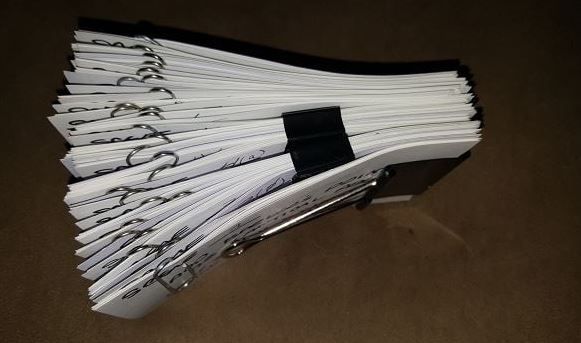
Plain old recipe cards like the ones your mom used to write down her mother-in-law's Sunday dinner recipes that she wouldn't make in a month of Sundays because her mother-in-law was a lousy cook.
You know, THOSE recipe cards. 
 
 
The photo above, showing all my scene cards for AIR, is the entire book in a 4x6 rectangle nutshell. Below, I'll explain the paper clips you see there as well.
 
You can buy recipe cards for super cheap in a dollar store or go whole-hog-highfalutin with the executive kind at Staples if you're still jonesin' to spend dough. It's a free country.
 
I advise buying the BLANK ones, so your creative mind won't be stymied by the lines. Blank ones can also facilitate small diagrams drawn or what have you that might come in handy for scene cues.
 
1-2 summary sentences explaining what this scene is about - its plot purpose/character motivation and/or evolution/devolution.
NOT chapter cards, scene cards. Don't think rationally, think creatively.
Worry later which scenes get lumped into which chapters.
 
Paper Clips: I've attached cards BEHIND each scene card - I call Factoid cards - that hold extraneous information - scientific and/or historic facts/data, quotes/poems/lyrics to be used, dialogue lines - basically any outstanding info I'll need to complete that scene. You can color code those factoid cards to denote certain subject matter if you choose - exs. green for quotes, blue for science/data, brown for historical data etc. Also, you can put emergency add-ins cards at the front of the pile, maybe written in red, of details you forgot to write into the first draft. 
 
Note: color coding is NOT a must. Only do if it makes you find what you're looking for quicker. This step is not for fun, peeps.
 
Fill out these cards with all the scenes from start to finish, as you know them now.
They can be changed, deleted, altered in their line-up at ANY time.
They can be carted with you in your pocket, a couple at a time, to an outside venue, when you do NOT want to plug into a device. (Yes, Scrivener has the same virtual deal, but those cards aren't real. You need to be on your computer to access those. Why limit yourself? And why pay for Scrivener when any word processing blank page will do?)
 
With my first novel, my mother was ill and in the hospital where Wi-Fi wasn't available. I wrote most of that novel from those cards, on paper in endless waiting rooms.
 
Note: You do NOT have to adopt my method.
I'm just saying choose ONE, one SIMPLE and EASY to use medium that is CHEAP on money and stingy on your time.
 
What counts isn't your project supply chain. It's those words down on paper. However they get there, they get there. Don't reinvent the wheel to get there, and waste scads of time and money in the process.
 
Now, be off with you!
Scene on!