Showing posts with label Book Writing. Show all posts

31 August

I'm Not Writing, But I LOVE My Process...


*sigh...*

I'm not sure why, but in the newbie writer world there seems to be a lot of stubbornness. I suspect it has more to do with feeling self-conscious and craving approval than anything else. No matter as to the reason, if your writing process does NOT have your writing consistently, it.....*drum roll...*

SUCKS.

Yes, you read me right. That process is about as valuable as a Blue Light Special at K-Mart (for those of you who are too young to get that analogy, too bad. :-P)

I had a conversation with a writer the other week, where he complained of being bored. I asked him why he wasn't writing, and he said he wasn't inspired. 

To wit, I explained being a serious writer has zilch to do with muse-like inspiration. 

To wit, he said to me, everyone has their own process. 

To wit, I said to him, looks like yours isn't working. 

To wit, he said, oh, it works fine. Not everyone has the same process. 

To wit, I said, true, but those who write consistently, not feigning being bored or uninspired, have a workable process. You obviously do not.

To wit, *crickets*

Ah... I love the smell of insecurity in the morning...

At some point, all writers, especially new ones, who decide that writing will be a career, not a hobby, have to look themselves in the mirror and ascertain if their writing process is actually a good one.

Just so you know, that looking into the mirror gig... you'll do it for the rest of your life. Nothing stays status quo for the artist. On about a monthly basis, after 8 years of full time writing, I have to do this self-examination, as my writing deadlines/demands keep increasing, so my process needs constantly refining.

My latest milestone: I need to write ~ 50,000 book draft words every 3 weeks, and have it become the norm, not the exception.

How do ya like them apples, you non-consistent, process holding, writing scribes???

So, to date, my process isn't working well enough. Currently, I've decided on a Time over Word Count approach, to see if that will up my production. I will study that process over the next few weeks, and see if it's successful. If not, back to my self-examination mirror I go to further tweak my process, and I will do so until I can settle on one that does get me to my goal.

So, now, it's YOUR turn...

HOMEWORK: 

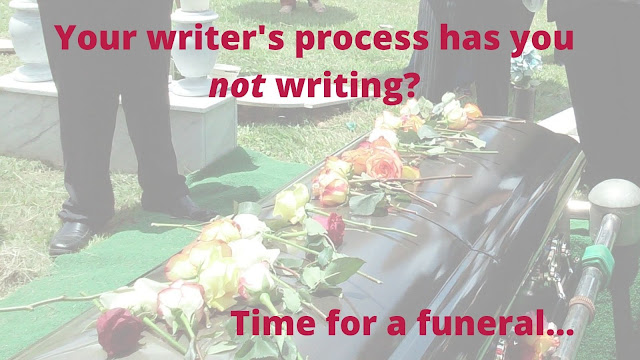
a) drop the stubborn facade about your non-writing process you hold so lovingly in your arms and figuratively pet. If you're not writing, your process needs to be killed. You can have an ornate funeral for it, if you wish. I get the diva in all of us...

b) establish your own book writing goal(s), and design a new process that you think may get you there. Assess it after a few weeks of implementation, and decide if it's working, or it needs further refinement.

c) and never be stubborn or proprietary or defensive about your writing process ever again.

The rubber meets the road strictly by the words down on the page. Nothing else matters.

Being a writer is mostly a psychological war with yourself. Constantly find new ways of winning each battle, to win that war.

29 July

Dear Book Writer, Just Say STOP...


STOP.

A pretty big, small word.

It warns us of impending danger ahead, to pause, look around our space, and be on alert, and only after we see the coast is clear, do we move on.

The voice inside your head is the dangerous one. It keeps whispering why you cannot write on your book today. Umpteen different reasons, excuses, colorful pastimes that your voice mumbles in your ear...

"I can't write today. I have to do ___."

"Writing? Now? Are you kidding! ____ is waiting for me." 

"Oh, yes, I was going to write, and then ___ happened, and I couldn't."

Blah-dee-blah, blah, blah.... yatta, even...

The Key: Have you asked yourself the REAL question? Is my brain a danger to me?

Sure, the flip side to that argument is your brain is trying to protect you from danger ahead, from committing mistakes or being laughed by your book readers. But do those dangers really exist? Could it be your Ego whispering to you, niggling at you to stop being a fool by writing on that book, instead of your reasoned mind?

A writer, like anyone undertaking any métier, has to judge what a) is a real danger, and b) when to STOP for what.

If your inner voice is a danger to you by offering up a plethora of excuses not to write, then you need to sit up, plaster on a stern expression, and say out loud, and with conviction, to your fearful self, "STOP, just STOP IT."

This audible trick works. It tells your Ego to shush it, to go back into its narcissistic cave and be quiet already, as you have legitimate work to do.

On occasion, I've needed to express this order to myself when my Ego rears its ugly head and tries to stop me from producing. Right now, I have a huge list of new book projects, and tickling my brain is that evil-doer, whispering in my ear why it's much safer not to open my laptop and add more words to those manuscripts. But soon enough,

  • I literally get fed up with that whispered BS.
  • I sit up.
  • And I say out loud, "STOP IT. Just STOP."

Those spat out words jar my psyche to realign my definition of danger, to ascertain there isn't any, so I can move forward, open up my laptop, and start writing again.

Sooner or later, you, like me, will have to contend with those opposing forces — the Ego and the Writing Mind. No shrink in the world can tell me those two are one and the same. They are not. It's a Battle Royale to the finish with each manuscript. 

The Bad News: That Ego beast never completely goes away. It lurks, lays in wait, breathing heavily... (frig).

The Good News: Your Writer Mind gets stronger, and wins more battles over your Ego, the more you write (yay!).

MY ongoing battle:

  • My Ego is all up in my grill because it doesn't want to be seen as anything but perfect to the outside world. Pathetic Ego.
  • My Writer Mind KNOWS I've written well before, many times, so realistically I'll write well again. Cheers, for the mature me!

As a new book writer, you have to come to this realization yourself, that you are fighting a foe that's only in your imagination. And with each new book project, it will whisper again to you to do anything but write on that manuscript. The bigger, more mature, adult you must stop that Ego monster in its tracks by simply saying out loud, "STOP." It will hear that word, finally shut up with the excuses, so you can move to open your much-abandoned laptop or notebook.

HOMEWORK: Try this small exercise the next time you hear your Ego whispering to you. Try it TODAY, TONIGHT, if instead of writing on your manuscript, you end up:

  • doing laundry 
  • vacuuming
  • playing video games
  • Facebook scrolling
  • fishing lint out of your navel.
You'll be amazed what your mature mind can do, say, to get you to stop for the real danger — that lazy lout, Monster Ego — and instead move forward on your book. 


P. S. It's okay to give your Ego a name. Mine is called Barbarella. She's a hot mess and leaves a wake of trouble everywhere she goes... 
 
Before I sat down to write this article, I fed her a dose of  ZzzQuil. She's snoring contently. ;-)

28 May

Writing vs Promoting - New Writer Ratio...


New Writer Activity Ratio: 95% Writing/5% Promoting... or, at least, it should be.
 
New writers get caught up in the social media Group Think/Peer Pressure cauldron, thinking the way to literary success is doing everything else BUT writing.
 
That's like a beginner pianist dusting the piano, sorting the sheet music, adjusting the bench, and not laying fingers on the keys, practicing playing the songs.
 
Are you chuckling now, rather red-faced, secretly relating to this go-nowhere-fast pattern? 
 
As in all things in life, don't put the cart before the horse. Evading hard work doesn't make that work disappear. It just prolongs the agony. Seriously. Rip the band-aid off quick.
 
You. Need. To. Write.
 
That is the ONLY WAY you will actually succeed as a writer, to graduate from new > to experienced > to skilled > to master.
 
There are a million words you haven't written down yet that you need to in order to gain the skill to write competent, lyrical passages that will deeply affect your reader. 
And no, social media blurbs do not count.
 
Social media promotion/exposure has its place, and is beneficial...AFTER you have something to promote and expose.
 
What do you think is the ratio between new writers who TALK about writing and those who actually WRITE? Refer back to the Writing ratio at the start of this post to give you a hint... ;-)
 
Yes, on your free time NOT designated to write, you can...
1) set up a FREE author website - do NOT pay out money where you haven't earned any yet, peeps.
2) register on your top 2-3 social media sites - an author page, NOT your personal page, and you can post pieces on your experience as a new writer, NOT personal junk.
3) attend writer conferences and take copious notes in seminars covering literary topics of which you need more knowledge.
 
But NONE of those three activities above should EVER steal one minute away from your writing sessions. Not. One. Minute.
 
HOMEWORK: if you haven't already done so, get serious today, and put together a weekly or monthly writing session schedule aligned with your ideal writing times you uncovered in your 2-week activity diary I told you to previously complete, to find those key times when you're awake, healthy, and free of job and domestic responsibilities, which might mean stealing some time away from your Goof Off hours, and there are many — TV, video games, naval-gazing, etc.
 
If you're only reading me and not actually setting up a proactive system to write, you're doing yourself and that unfinished book no earthly good.
 
Until that first book is finished,
95% write
5% everything else
 
As a new writer, there is NO other doable ratio to literary success.

04 May

Fear of Writing, Fear of Loss...


Humans gauge the attractiveness of an activity by what they'll gain from it, immediately or long term. Those who seek immediate gratification reject the long term option, not because they can't see the end goal, but because they have decided they cannot endure the interim losses required to achieve that end goal.
 
And long term artistic endeavors have a basket-full of interim losses:
Loss of Free Time - FOMO — Fear Of Missing Out — to do more instantly enjoyable activities.
Loss of Brain Energy - needed to focus to write well.
Loss of Control - you are given no certainty that your crafted sentences are the right sentences.
Loss of Contentment - if you end up struggling/having frustration with a problematic sentence or plot hole or character motivation.
Loss of Material Rewards - you are given no certainty they will ever exist.

Writers need to be patient people, and many new writers haven't adjusted their expectations to long term gratification, accepting there will be many immediate losses along the way.
 
In any worthwhile activity, this short term loss vs long term win reality exists, and each of us has to decide what we're mentally prepared to give. This is why I loathe new writers who say they write because it's "fun." Already, they are ignoring or repressing this reality. I'm not trying to be a Debby Downer here. By actually mentally preparing yourself for these losses, to reach the ultimate goal, you'll be in a better frame of mind to endure those inevitable bad days of writing where you feel you'll never write yourself out of the book issues that rear their ugly heads.
 
Being realistic.
Being patient.
Being a long term visionary when everyone else around you can't see what you see.
It takes fortitude to master a craft. 
"Fun" and excitement about this "shiny new idea" won't get you very far.
 
HOMEWORK: make a list of Immediate Losses and Long Term Gains in finishing your book. 
 
Come face-to-face with your ultimate fear of loss, and once you do, you'll be far better prepared to march on to typing, "The End." 
 
Like in life, there's fun and there's work. 
 
Fun is cotton candy.
Work is steak.
In your goals, which one do you think will better sustain you?

26 March

Book Outlines - Scene Cards an Option...


How many of you have made up an outline for your book? If you have,
 
Have you considered writing scene cards over any other method? 
 
Scene cards can be switched around far easier than chapters written on a piece of paper, and your mind's eye will better view your tale in a single moment in time, holistically, over mere linear or numerical.
 
I will talk in a later post how to use scene cards, but for now...
 
Tell us what issues have've had in storyboard creation? Comment below.