Showing posts with label STOP Not Writing Now. Show all posts

11 October

Fear of Deleting Words You Fought to Write...


“Practice makes perfect.”

How many times have you heard your parents say that?

For me, that saying was right up there with, “We’ll do that (exciting thing) one day.”

And “No, we can’t wrap up your uneaten pork chop and send it to Africa to feed the hungry.”

Okay, yeah, I have parental issues.

16 August

Visualize to Maximize Your Writer Words...


Skiing - you head down the slope without thinking about how you will guide your skis around the curves.

Tennis - you head onto the court, not knowing how your racket will meet the ball.

Cooking - you throw a bunch of ingredients in the pan, having no idea what the dish is supposed to be.

I could go on and on, and on, couldn't I? You know me by now. Oh, yes, I can...

Why then, as a teller of tales, would you not at least attempt to visualize the story before you pound the keys or put pen to paper?

19 July

How Writing Every Day Made Me a Better Person...


If you think becoming a full time writer is all about typing words onto a page, and nothing more, you’re missing the literary boat.

Writing every day makes you a better person. Seriously.

Writing, whether fiction or non, is 80% psychological, 10% skill, 10% practice.

Anyone tell you any different, and they’re lying.

It takes a vision for your future, determination to undertake that vision and true grit on the days that the writing comes about as easily as walking through Flanders Field mud as the WWI bombs are dropping all around you.


How Canadian physician, Lieutenant-Colonel Jon McCrae, managed to pen In Flanders Fields amid all the blood and death and filth and rats and bombs is anyone’s guess. Think of Lieutenant-Colonel McCrae when you decide to moan about your writing day.

21 June

Writing Through a Personal Crisis...

I won't kid you. This is the most difficult thing a writer can do. 

When your world crashes down, and you still need to produce content to make a living. Liken this emotional feat to being given horrendous news and then having to step on stage and woo a crowd with your swan song, delivering happily when all you want to do is crawl into a ball and cry.

25 May

Live to Write, Not Write to Live...


I get it.

As a writer, sometimes the only freedom you feel, the only way you feel alive, is behind the keyboard, saying on the screen what you might not be able to say in person.

If that fact didn’t exist, doubtful books would have ever become a thing.

But, as a new writer, often obsession takes over reason, and you end up thinking the only way to live is to write, abandoning your life away from that keyboard.

Das ist nicht gut, as the Germans say.

05 April

Fear of Being Hurt – Free Yourself from Control…

Fear of Being Hurt = Need for Control

That equation has been around since our caveman days…

Caveman fears being eaten by sabre-toothed tiger. Caveman starts fires around the perimeter of his encampment. Caveman assigns other cavemen to stoke the fires and keep a watch-out, with spears in hand, all through the night, so the caveman village will be safe, no caveman or cave woman will be eaten.

Flash forward a few eons…

Cave Person Writer: Fear of Writing Failure/Ego Hurt = Need for Control

I’ll put off writing to insure no hurt. I’ll wait until I know all risks are well under control before I write, so I won’t get hurt.

True. If you control all the ways in which you will not be hurt; i.e. just don’t write, just don’t put your work out there to be judged, for YOU to be judged. Yeppers, you not writing, you figuratively setting those encampment fires, will keep those literary judgmental sabre-toothed tigers away, and your Ego won’t be eaten alive. But no art from you will live either.

Unlike the cavemen, your very life isn’t dependent on this need for control. Writing or not, you will have food to eat, a shelter over your head. You will wake up the next day, very much alive and well.

Alas, cavemen instincts are hard to shed, aren’t they? Humans are not as evolved as we like to think we are, and I wonder more so sometimes about writers. Fear, doubt, they seem to pervade this artistic group like no other, as if to have someone read words we’ve plunked down on paper is like a doctor doing surgery on our heart with a rusty knife.

Solution: Relinquish Control. Let it go. Nobody will die here.

Plan, yes. Make a plot plan. Create a character bible. Formulate your non-fiction thesis with talking points. But then, LET GO. JUMP. Let your Ego hit the air and fall with no net to catch you. ASSUME YOU ARE TAKING RISKS.

Mind Morph: Learn to EMBRACE the RISKS. Assume every time you put pen to paper, you are jumping, free-fall.

Your Job: is to create, the best you know how to do at this very moment in your life.

Readers Job: to absorb what you created.

Result: Acceptance, Rejection – NOT YOUR JOB. Once your work is out there, it’s NO LONGER YOURS. Now, it belongs to the world. Know that. Accept that. FREE YOURSELF from that WORRY. You did the work to the very best of your ability: Draft, Read Out Loud, Self-Edited, Beta Readers, Pro Edited, Re-writes — Published. Done.

The work was your effort. The mind exhaustion, the focus needed, that was the only hurt you will ever need to absorb, and that kind of hurt comes with EVERY JOB OUT THERE, from plumber to pastor, from politician to pastry chef, from post hole digger to philosopher.

As a human, Work = Effort. That’s a fact of life. That is trans-generational. But the mind/body hurt from expending energy on a task will be healed through rest after the work is done. Being tired is not a death sentence, peeps. It lets you know your effort was worth it. It resulted in a worthy product.

HOMEWORK: Jump. Hit that air. Accept that there is no safety net to creating.

Reality: Control is really just an illusion anyway. Humans only think they are in control. So why hold onto something that’s a mirage?

Jump. Write. Free-fall.

Live to enjoy the literary ride.

29 March

Learn from Everyone, Compare to No One…


“Be a sponge.” ~ That was the best advice I had ever been given by a professor. Learn from everyone, anyone, all the time. If you don’t stay open to knowledge, you won’t grow in any métier.

“Be yourself.” ~ Another advice gem, but one I’ve fought with over the years simply because I have always walked to the beat of a different drummer, always slightly out of step with the “norm.”

But as the years have wandered by, I’ve come to see that both pieces of advice are crucial if you want to be the best artist you can be, and create stellar works, not as a rarity, but at a regular pace. Harper Lee despised that very American tradition of readers asking, “What’s next?” But reality shows that art is voraciously consumed, and especially when it is good, so that dream of the Great American Novel had better be pluralized, or you’ll be seen as that scornful “One hit wonder,” which is cool, I guess. But if you asked rocker, Peter Frampton, or Harper Lee, they may have a different take.

"How does this pertain to Writers Block?" you ask. Simple.

Learn, grow, without horse blinders.

Create with those blinders on.

Comparing yourself to others will have you stop creating so fast your head will spin.

Comparison can be the death knell of an artist.

Yes, your idolized writers are great. They’ve made wonderful works. But they are not you and your works. They could no more create you than you could re-create them.

I happen to be a fan of Herman Wouk. His WWII epic, Winds of War, enraptured me. It may be the only fictional work that truly took my imagination hostage and allowed me to exist back in those harrowing years with characters who reminded me so of my parents and their generation.

But I had to accept that I would never write exactly like Wouk. I did write a WWII epic, but it’s written in my style, my take on that slice of life. It reads not like Wouk. It reads like me. As it turns out, when asked, Wouk had criticisms of Winds of War, as I have criticisms of AIR (to be published in December of this year, here’s hoping). No artist is ever completely satisfied with their own work. But great artists know when they’ve given their all. Comparison by others is never injected into that success equation. We artists do OUR BEST with the knowledge and skill we have at that particular moment in time, and we give that work to the world, and we ACCEPT that piece of art exists as it should as a time capsule of a particular artist who happens to be YOU, and you alone.

Once I learned to accept this fact— and yes, holy heck, am I a slow learner! — that I AM different from the norm and that is a GOOD thing, I stopped fighting to be somebody else! I accepted Wouk as being Wouk and me, Thompson, as being Thompson, and although I learned heaps from Wouk, I created as Thompson. I accepted that I am different from Wouk and every other artist alive or dead. I accept that I am different because I am an artist, and I am an artist because I am different. You cannot separate the two.

ADVICE FOR YOU, oh newbie book hack: STOP comparing yourself to others, only learn from them. Elevate your skill, but create inside yourself.

FACT: You will never be anyone else but you. You will only create what YOU create. It wouldn’t matter how many times you slobbered over others’ works. You will never create like them. Accept this fact. Acceptance of this will STOP Writers Block in its tracks, for those seemingly insurmountable hurdles of being like someone else will be gone. You will use skills you’ve learned from all those other greats to create YOU, your works, with YOUR expression, with YOUR message.

HOMEWORK: Don’t take decades like me to wise up to this fact. Accept being you now. Keep your ears to the ground and your eyes open to learn. Then, with the skills you’ve acquired, go off somewhere alone and create YOU. Accept the fact that is all you can create. And know the world is waiting not for those other greats. It is waiting for YOU — YOUR work. YOUR art. YOUR beautiful take on life.

And that, simply put, is the rarest gem of them all. Only you hold that bobble. Are you now willing to start writing as YOU, so we readers can take a peek at your singularly shimmering jewel?

Okay then. YOU, start pounding those keys today.


15 March

Story Brainstorm - Sink that Writers Block Boat...


Your mind's eye saw the start of your tale.

You motored along... click-clacking away with wild abandon...

Then, your fingers stopped. You stared at the screen. Your mind went blank. The cursor blinked on, and off, and on, and off, and OH, FOR THE LOVE OF PETE!, and off...

You knew it. The chickens finally came home to roost. You have nothing. You're an imposter. A writer wannabe. Your plot creation brain you thought you had hung a sign on your synapse door, reading, Gone Fishing.


Crikey. Just when stuff was getting good, too. Janey was almost up the hill. She could see the lighthouse in the distance. The black silhouette shape menacing her,  pursuing her, was gaining speed...

Annnnnnd, yep, there it was. Nothing.

  • This is NOT the time to berate yourself. This is NOT the time to berate Janey. She's doing her best with what you've given her, which is zilch. She should jump off the page and hit you with something hard and sharp.
  • This is not the time to swear; although, I won't hold it against you if you do (says me, the drunken cursing sailor).
  • This IS THE TIME to brainstorm. NOT to quit. NOT to bash your tale or your characters or your creativity, or look derisively at your pet who's made a bed in that pile of printer paper, blaming that poor wee fur ball for your mis-tale-deeds.

As I've said before, you can't make it out of a dark forested tale if you don't know your way.

Dos:

  • Shut down that laptop.
  • Pull out a sheet of paper and your favorite pen.
  • And start brainstorming... scribbling down every insane thought that comes your way, vis-à-vis Janey and that lighthouse, and her menacing pursuer.

Instructions:

  • Do this top-of-mind exercise for at least 30 minutes.
  • List Action - Cause - Effect outcomes for each idea.

Example: 

  • Idea #1: Janey turns around - picks up a fieldstone - throws it at her pursuer > and misses. Ugh.
  • Idea #2: Janey hides under a bush - waits for the pursuer to run by > they run by, she's in the clear! Oops, the pursuer smells her Chanel No. 5 she sprayed on herself this morning in the hopes she'd bump into Rex at the hardware store > pursuer finds, her, takes that fieldstone, and bashes it over her head. Ugh.
  • Idea #3: Janey stops dead in her tracks, waits for the pursuer to catch up. She sees it's Rex from the hardware store. They run into the lighthouse, hand in hand, and make passionate goo-goo eyes at one another. > Aww.... that's the one!

(Psst: Rex is a lousy kisser, and he doesn't know a Philips from a Robinson. Methinks, this tale isn't going to end well for Janey. ;-) )

What I Need You To Do:

  • Brainstorm with this Action - Cause - Effect exercise into AT LEAST 50% of your book.
  • Yes, no plot point is carved in stone. You can alter at any time. But it will force your brain to CARVE A PATH to safely get your writer self out of that dark forest tale.

The Juicy Benefit: Your fingers will not be able to keep up with those brand-new visuals inside your head. You will be a story-telling master of your new plot world!

Now, the only thing that'll make you curse is the regret you have at not taking that high school typing class more seriously (Okay, that may be just me. I'm the only typing organism I know who mastered the fingering and as soon as I passed the course, returned to my two-finger pounding... sigh...)

HOMEWORK: If this is you today, STOP STARING AT THE SCREEN, shut down the laptop, and start brainstorming. Consider this the exercise you need to find that compass or GPS to get you and your characters through this exciting adventure. 

  • ASSUME you'll discard 80% of those brainstormed ideas, keeping 20. 
  • Write each subsequent plot point down on real or virtual cue cards.
  • Start flipping those cards in the order in which the tale unfolds in the book.
  • Keep doing this until you run out of cards, then repeat the brainstorm process, until you type The End.

Don't make your writer life harder than it already is. KNOW WHERE you're going. 

This is a general carved-out path for you to follow that WILL STILL ALLOW for on-the-spot creativity, but will NOT get you lost in that plot forest or drowning in that leaky Writers Block boat.

Being a writer doesn't assume that by laying fingers on keys the Story Gods will bleed a wondrous tale onto the page for you, simple-dimple. Maybe that's your uber-romantic notion of this career, but that's Hollywood versus reality.

Your New Mantra: YOU NEED TO KNOW WHERE TO GO. Say it with me, now,  three times... la-dee-da! Get up from your chair and do the mantra dance! I'll wait.

Now, with those newly minted plot cards in hand, go and storm your world. 

That leaky Writers Block boat has gone out to sea. Oops, there it goes, stern first, into the drink. Glub, glub, bubble bursts... so sad. (DIE! DIE, I say!)


08 March

STOP the Wandering Writer Mind – Your Clue to Get to Work


Your book draft isn’t done… but you’re searching the web for book cover artists.

Your book draft isn’t done… but you’re researching editors.

Your book draft isn’t done… but you’re lining up podcast shows.

Your book draft isn’t done… but you’re purchasing author merch.


Sound familiar?

Two words for you: STOP IT.


The ONLY way you can better your writing habit is by recognizing the activities which take your writing off track. One is the Wandering Writing Mind. This animal has the eyesight of an eagle at 5,000 feet for anything new 'n' shiny, anything easier than writing, that'll waylay your goal of completing that draft. 

And I mean anything. Seriously, ANY. THING. The actions of a waylaid writer can be hilarious to watch, if they weren’t so sad.

Triggers. You’ve heard that oft-used buzzword. Well, consider this a trigger, a clue, for you to recognize, so you can...

  • STOP what you’re doing.
  • Realize this is an escape mechanism you sub-consciously employ.
  • Realign your activity back to that draft.
  • And leaving the escape until AFTER your writing session is done for the day. 

From the outside, people think a writer's life is blessed. Considering the mental exhaustion suffered by a writer after a decent writing session is had, it's maybe more of a cursed life. But hey, we're writers. We can't be anything else. We've tried. We've failed. So, we write, cursed or not.

For a personal example, consider myself, and today…

My house is a 4-alarm mess. I mean, dust bunnies pairing up with dust mites, dancing to the rousing beat of a mariachi flea band. Shoveling, jack-hammering out the dirt may be a more productive way to clean this disaster area than the old vac and dust routine.

I had to get the rec room done today (long, boring story), BUT I ALSO had to complete my weekly social media activities and articles, like this one. (FYI, cleaning for me doesn’t just mean the superficial vac ‘n’ dust. It usually means moving furniture and fumigating the diabolical paw print slime my family leaves in their slovenly wake, in the month I choose not to get off my butt and clean (also long, boring story).

It took me 4 hours to complete the rec room.

My muscles are sore. I'm dusty and dirty, and dead beat. All I WANT to do is veg in front of the TV.

But I KNOW that’s MY CLUE. I’m trying to ESCAPE from my writing work, which also demands my attention.

Minus a severe illness, hospitalization or a fun bout of simply bleeding out and croaking, I KNOW there is NO EXCUSE to not get my writing done each work day. NO. EXCUSE.

  • Nothing new 'n' shiny. 
  • Not a romp to the mall or drinks with a friend.
  • Not working in my yard or the garage or playing a video game or lazing in a bubble bath.

Nothing beyond doing my work is the accepted task before me.

So, here I am, dirty, dusty, housework icky me, completing my writing To-Dos for Tuesday.

Afterwards, I can do what I want, even if that means only a shower and collapsing into a bed coma. But that escape pairing is AFTER finishing my writing work. I recognize my escape clue, and I work IN SPITE of it. I know it's just my urge to escape the hard writing work I need to do.

HOMEWORK: Today, make a list of all the triggers/"clues" you find yourself up against when you should be writing on that draft of yours. Put that list by your laptop or near your phone, or near the coffee machine… anywhere where it’ll remind you that you’re falling for that ESCAPE trigger, and to STOP IT, and return to your writing work at hand.

There’s a time for work and there’s a time for play. Remember your priorities. Put that work horse BEFORE the play cart, not the other way around. Your book draft, and your guilty conscience, will thank you.

Now, excuse me while I head to the shower and delouse. ;-)

01 March

Writer Voice - Write You, Not Them...


New writers... they're a special breed.

Coming off eons of notebook navel-gazing scribbles and polished pro reading... these new scribes KNOW what's good and what's not, and by gum, they'll write freakishly polished first drafts, or not write at all! If The New Yorker or the New York Times don't hire them on the spot after just their first article flying into the ether, then, at least, their first Pulitzer Prize will arrive by UPS later today. Yes. Right out of the gate. They will be THAT good.

I love new writers. Bright-eyed and bushy-tailed. Full of vim and vinegar. And hopes higher than Everest (with deadly literary crevasses as deep, but don't tell these gleeful souls).

The Newbie Writer Secret Recipe: they've read everything their favorite writer has ever written, and they have that pro scribe's literary voice DOWN COLD. These freshly brewed hacks will explode onto the word crafting scene as Idol Scribe 2.0. They even bought the smoking jacket and cravat their fav writer wears! There's nothing to stop their stratospheric popularity now, boy. One typed out word, and their accolades and riches await.

Did I mention I just WUV newbie writers?

~~~

Author Vignette:

For years, newbie writer, Hunter S. Thompson, typed out passages from F. Scott Fitzgerald's works in an attempt to morph into being Scott. Hunter often said that as Fitz examined, and wrote from inside, the well-heeled world, he, Hunter, committed literary B & E into that same world. And anyone who reads these two writers side by side will wholeheartedly agree. Their writer voices couldn't be farther apart if they tried, even if they shared the same deathly love affair with booze.

~~~

Stories like this wane and waft all over the place, where a fan dives deep into their idol's world, to emulate, to inhale that world. But although mechanics and line style can be well refined in following the greats, more often than not their voice is never found within those well-celebrated pages.

Why, you ask?

Because they are Them, and you are You. And you'll not be each other, ever.

New writers are frequently paralyzed by this need to BE somebody else. This is probably why they began to scribble in those notebooks in their teens.

They think to themselves, "If only I did this, or said things this way, or bought that, or travelled there, or drank here, or schmoozed with whomever my idol sidled up to..."

STOP.

STOP thinking, doing that.

You're wasting time and money you do NOT have for a quest that can never be fulfilled.

Hint: The world does NOT NEED another Them. We already have Them. We NEED YOU.

That one-of-a-kind, irreplaceable YOU.

We need YOUR viewpoint on our human experience. We need your heart, emotions, intellect and drive.

Yes, at first, as the newbie writer you are, your literary You will come with many mechanical warts, but over time and much practice, you will open our eyes and professionally deliver something we could have never received from those already celebrated Them's, not if we hunted for said for a million years. 

Scary Fact: Your word gifts will only last as long as you do, and every moment you're wasting trying to suppress them to be Them is time you're stealing from us — your future reader fans.

HOMEWORK: STOP trying to be someone you're not. Sit down, and start pounding those keys, expecting, nay DEMANDING, your literary warts to show, so you can correct and learn from them, and get ever closer to the stellar You, we're dying to read.

Moral of the Fitzgerald/Thompson Twinning Writer Voice Tale: both ended up married to the bottle, losing their ability to write, and dying a pathetic death well before their time. I guess that's something that's aptly copied over from idol to fan. Yay. (Not.)

22 February

First Line, First Page — STOP Obsessing, START a Campfire Tale...

First Line, First Page — STOP Obsessing

I swear…

So-called online experts want to scare the poo-poo out of new writers with their pressure-mounted one-liners, like, “Your first sentence, your first page, must be stellar!”

A new writer reads this, and thinks, Man, the last thing I ever did that was stellar was accidentally fly my HUUUUGE dragon kite near an airport, and get a fine for messing with incoming jet traffic. (Okay, this maybe a true story, and may not be your story. I’m saying no more…)

The last thing a struggling writer needs to read are words like the above, which passive-aggressively hint at, “Write perfectly, you heathen hack, or you’ll be forever tarred and feathered by all in the literary universe!”

The ONE thing I’ve learned about the literary world is there exists queer ducks in it who, in the act of attempting to help new writers, achieve the exact opposite.

Fact No.1: EVERY DRAFT OF EVERY STORY EVER WRITTEN IN CRAP.

I don’t care if you’re Joe Nobody or Ernest Hemingway.

I don’t care if you’re invisible on social media or are an influencer from hell.

I don’t even care if this is your first time at the literary bat, or you own the damn bat.

YOU WILL WRITE DRAFT CRAP. ACCEPT IT. EMBRACE IT. LIVE IT.

Soooo…

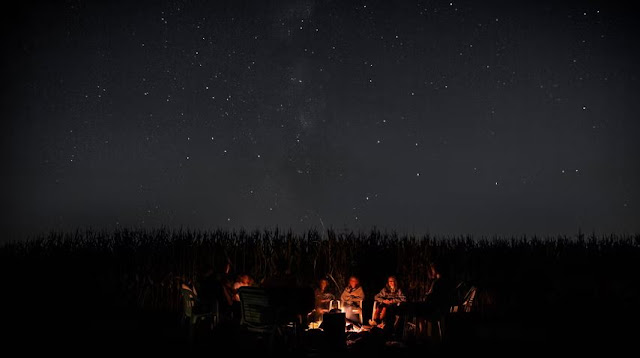
Instead of obsessing about creating that so-called perfect first line or perfect first page that’ll get you a book contract with a zillion dollar advance, plunk your creative mind down in front of that figurative campfire over there, and tell those campfire listeners a story. An honest to goodness story.

Don’t obsess about word choice.

Don’t try to shock and awe.

Begin your tale like you would if your friends were gathered around you, eager to hear your wondrous flight of fancy.

Sit down, and start plunking out the words that fit with the starting scene you visualize in your mind’s eye: Where are we? Who is there? What’s happening? Who is saying what to whom?

Chances are that what you’ve seen will end up typing out just right without you obsessing over anything. Either way, plunk it out, and leave it alone. It’ll ferment behind the scenes as you continue writing the story.

Your first line, first page, “perfectness” (hey, I’m a word weaver. I can make up words if I wanna) can come later in the edit and Read Out Loud phases. Right now, it’s all about your tale and how you are seeing it unfold, and nothing else.

Don’t let first line, first page article writers intimidate you into not writing at all.

Instead, wonder how many rewrites they undertook in drafting that article.

And wonder how supremely crapola-filled that initial draft was.

A HINT: if you’re having problems typing out the words, leave the laptop, and say the story out loud to yourself while recording it on your device. Replay it, and see what words you used, and type those down as a start,

THE KEY: When that first page is filled, LEAVE IT ALONE. Continue writing your story to The End, and then after you've let the finished story breathe for a couple of weeks, return to that first line, first page, and edit. Chances are now that the whole story is written, you’ll have a much better grasp of how to perfect that line and that page, obsession-free, stress-free.

HOMEWORK: If you’re first line, first page obsessing right now, STOP it, DROP it, and type on.

You need to write this tale to The End. Without reaching The End, that first line, first page perfection is moot.


Type on......


15 February

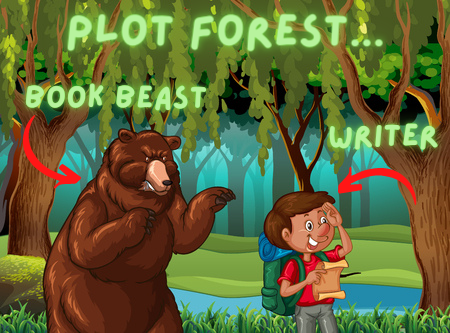
Mapping the Plot Forest to Escape the Book Beast...


Oh, happy day!

I’ve packed my sack. I’ve donned by sturdy boots. And I’m off to wander around my book’s Plot Forest… WHEEE!!!

The warm sunshine on my face.

The soft breeze…

I trek here, snoop there. It’s a wonderland of story ideas I can gather as plot treasure…

I sit down on the lush grass and I examine them all!

Hacking out words of awe, following each avenue, until…

Storm clouds brew.

Sky closes in.

A growing growling emanates from within the plot forest.

A big, old, hairy bruit — the Mighty Book Beast — lumbers up behind me!

I run! I run in circles! I run into dead ends! Round and round and back and forth, the Book Beast gaining on me with every step!

Fear, abject plot forest fear, topples me, and I roll, roll, roll down the craggy hill. Beaten and bruised, I gather my wits and my limbs, and I break free of that nebulous, nefarious forest, never to return again.

~~~

Yup. *insert look of disdain at you happy-go-UNlucky hapless plot forest trekkers*

~~~

Who in their hair-brained mind enters a literal or literary forest without a map? Who? Who, I say? Those whose desiccated bones are found years later in the mire and muck, their carcass splayed out on the dry, dusty pages the Unfinished Book Beast gnawed on that serene sunny afternoon when you were romping around your plot forest without a care in the world like some lobotomized Walmart greeter.

~~~

  • IF you’re new to book writing.
  • IF you haven’t yet finished one book, much less many.
  • IF you haven’t a clue about what it takes to create a complete, well-formulated story plot, with highs and lows — action tension and narrative pause beats.

Then what in the fricken fairyland are you doing gallivanting in a world in which you haven’t a clue to safely traverse?

Yes. Expert writers, who know their genre plot line backwards and forwards, can begin and end their tales without much prior mapping, but that skill level can take years of experience with umpteen finished books under their arms.

If you’re new to book writing, here’s a Fun Fact: YOU AIN’T THEM.

Yeah, yeah, slay me, your one and only realistic Messenger, like I haven’t been slayed by other newbies before…

As an example, I’ll give ya a short Don’t Do This tale…

Recently, I started a brand-new series, entering into the murder mystery genre world. It's a venture customized for online readers who want light and airy, Pringles potato chip addicted tales of mayhem fun.

I dove into this project before taking a break after finishing a very complex WWII literary epic-length work. I was mentally exhausted. That state hampered my reasoning, and in taking on this series, I began to write in a desperation mode that is not normally me, by beginning the four-book tale with only a bare-bones plot line.

That slip-shod preparation has made finishing Book One a far more tedious, far more edit unfriendly exercise, taking me many months to finish when it should have only taken me one.

I know better.

I’ve always prepared at least 80% of my scenes before I've plunked even one laptop key.

But in my desperation to finish this new project, I threw my brain out the window, and with it any semblance of order and expediency in finishing the first book.

Yep. Even an old dog needs to RELEARN old tricks. Seriously. If you look up the word, pathetic, you’ll see my dumb-as-a-post mug blithely smiling back at you.

Fact: There is no getting around mapping out your book. I don’t care if it’s fiction or non. I don’t care if it’s 50 grand or 500. Before you slam those laptop keys, know where in the heck you’re going, realizing your book's outlined scenes are equivalent to having a map in any forest you plan on escaping alive.

HOMEWORK: Today, if you’re stuck, if you’ve stopped writing because you haven’t a clue as to what to write next, STOP Writing, and START Mapping. Outline on cards what happens in each scene, what characters are there, and how that scene forwards the fiction tale or non-fiction thesis. There is no way around this pre-writing exercise if you're new to the book writing game or have taken on a new genre.

Do NOT listen to the so-called Pantsers out there. For every book they plunk out in a micro-instant, sky-high on their wayward glee, picture their post draft future bogged down like a trapped animal in an editorial quagmire that will take forever to clear, or cost big bucks in pro-editor fees.

The best quality/time/cost-effective way to finish a book? Start with a complete map. A universal rule of thumb Yours Truly sadly forgot on her way down Desperation Alley. *slapping myself with something hard and sharp*

My Book Two: Heck, yeah, that baby will have a V-8, 3D plot map that will glisten gloriously in the warm sunshine when I next trek through the plot forest. It’ll come with Book Beast Bear Spray, too, it’ll be that good.

My Plot Map Heaven... so grand...
 

08 February

Grow Your Writer Grit...


Remember back…

When your parents made you do some back-breaking chore that was dirty and awful and boring, and you felt was a complete waste of time, but to get your allowance, you kept that verbal goodie to yourself, and did it anyway?

Remember less far back…

When a university prof made you do a pathetically meaningless assignment, and made it into a compulsory group project (ugh), and you faked smiled at your team, dug in, became the group leader, assigned chores, to get that pissy project done and dusted in lightning speed?

Remember yesterday…

When you woke up, feeling like crap — a Covid side contagion more virulent these days than the coronavirus itself — and you couldn’t even force yourself to look at your laptop, much less write on that endless book of yours?

So, today, I ask…

What happened to your Grin & Bare It Grit?

  • You had it when you were 8.
  • You had it when you were 18.
  • Where did you put it at 28, 38, 48, and 58?

I hate to dent the romantic notion newbie writers have about full time writing… (but I will, you know I will…) a writing career has more to do with digging ditches in a cold rain than it has to do with sun-kissed beaches and smoking jackets worn by a crackling fire.

The digging is daily. The mind exhaustion is daily.

It’s mind-breaking, clumsy work, whereby you spill truckloads of prosaic crap onto the page to discover a few good gems.

And even when you finish a work, you’re never finished. The world always demands the next book from you that you haven’t even started yet.

And accolades maybe years in the achieving, kind of like when Tom Hanks was forced to do Faberge shampoo commercials before being a superstar. And the odds of you and your work going from Tom Hanks Zero to Zenith aren’t even looking that good.

As a kid, you knew hard work had its own reward. By age 8, you knew patience was indeed a virtue.

So, I ask you…

Where is your growing grit around being a writer?

You know writing is beyond hard.

You know you’ll screw up, learn, grow, and screw up some more.

But is there anything more satisfying than to have weathered that literary storm, and come out the other end better than whole?

If you answer, "No, there isn’t," then you need to find a way to grow that grit you’ve had in you since you weeded your mom’s garden, and those bloody dandelions came back the next day, twice as big.

Some things in life are just plain back-breaking, and they get you frustrated, and they put you down in the muck and mire, fighting tooth and nail to make prosaic goo read great.

But…

What would you do, that would satisfy you more, if not write? All that avoiding activity you're doing right now is making you feel worse. How 'bout trying to write, and feel better?

HOMEWORK: Go have a shower. Put on some fightin’ clothes. Brew a pot of strong tea or coffee. Plunk yourself down at your desk, INHALE DEEPLY, and get in that ring, ready to word rumble! And do all this NOW. No. not tomorrow. NOW.

Nobody, especially me, ever said being a writer would be a trip. And if it were, you’d end up being in the Slow Lane on the Scenic Tour from Hell for the foreseeable future. It’s just part and parcel of the fight to be a great artist. There’s your cup of reality. Go sup.

  • Weeding the lawn.
  • Digging a ditch.
  • Washing dishes by hand ‘cause the dishwasher broke.
  • Mopping floors.
  • Washing walls.
  • Scrubbing toilets.
  • Writing your book

Right? Am I right?

You know I'm right.


 This is Gary Grit. he has it goin' on...

01 February

Your Writer Muscle - Get It a Trainer...


Wacky Scenario...

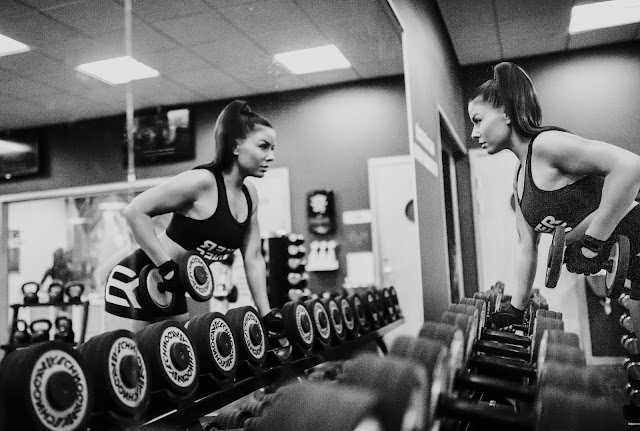
So, one day, I decide I'd like to be a body builder. I read one lousy article on the profession, get inspired, and say, "Yup, that's the thing for me!"

So, I head to the gym, and lift weights until I can't lift weights anymore. I head home, feeling grrreat! The next morning, I awake, and I can't move for crying, "Mommy!" Every muscle in my body is screaming at me... saying,

"What in the holy heavenly hash did you do to us??? The last thing we muscles remember is your love of the couch and Netflix."

I end up in such pain I don't return to the gym for weeks, maybe months, maybe never, because the trauma on my body was too great.

~~~

Hey, you hackers of words out there... you getting my drift?

~~~

Muscles can't be expected to perform to Olympic standards right out of the gate... if they've never even seen a gate.

Those muscles need to be trained to perform, right? Right?

"Everyone knows this, B.J.," you say.

"Oh, really," I say. "Then why do you think your writer muscle can go from lifting 0 words per day to 2 grand, in under a day, every day?"

From you, I hear *crickets*.

~~~

Like with every other skill humans can acquire, we do it over time and through practice. Humans are not gods. We need to train, learn, and train some more. And we writers need to train in intervals our never-before-used writer muscle can withstand. Otherwise, that muscle receives trauma, and it drops working on that manuscript, possibly never picking it up again.

Sound familiar?

HOMEWORK: If you haven't yet done this, keep a 2-week diary of when your time and energy is at that free/sweet spot, and once you know when your writing sessions can occur per day/week, set yourself a word count goal for each session.... then CUT THAT NUMBER IN HALF.

Yep. You read me right. Half that sucker. Heck, maybe even quarter it.

Your writer muscle can't hack out 2 grand/day if you've never worked it like that before.

For you, CONSISTENCY is better than word count. Seriously.

I'd rather see you open your laptop every day for the next week, plunk out the word, "the," close your laptop, and REPEAT that process til the end of the week, than see you grunt and groan out 2 grand on one single day, and never open that laptop again.

The KEY: Up your word count GRADUALLY, OVER TIME.

The LONG TERM HOMEWORK: Write EVERY DAY for the next 42 DAYS, even if all you write are 42 "the's."

The FACT: It takes a human at least 6 weeks to move an action into an automatic habit. 42 days.

  • Keep a calendar. Cross off each day of those 42 where you wrote.
  • If you skip a day, START OVER. Yep. You read me. Start. Over.
  • It might take you SEVERAL TRIES to get in those 42 days. It surely did me. THAT IS NORMAL. THAT IS NOT FAILURE. Stop blubbering...
  • And do this writer muscle heavy lifting until you manage to write every single day of those 42.
  • I don't care what you write. You can pen a hate mail letter to me. Like you'd be the first to do that... ;-)
  • You NEED to train your brain to the process of walking to your laptop, opening it up, plunking down some words, saving, closing the laptop, and repeating each day, to gain strength in that writer muscle, so that you'll be able to write every day, and for the rest of your writer life.

Now, be off with your skimpy writer muscle, and start training that sucker. 

Morty Muscle... ready and rarin' to go!

 Morty Muscle is a couch potato right now, so be gentle with the wee dude... ;-)