Showing posts with label Scene Cards. Show all posts

14 September

Not Writing? Return to the Scene Cards...


If you've been in a writing frenzy, your fingers not able to keep up with your mind, and then, all of a sudden one day, your fingers stop. Cold.

They won't move. They won't budge.

They're the equivalent of a stubborn mule.

You curse them. You talk to yourself.

"What the heck? Get going already! We're at that part where the feral rutabaga storms in on the alien monkey, and lasers are lifted, and—"

Nothing. Nope. Fingers don't care about that climactic laser duel. Couldn't care less. Fingers close the laptop, and they walk away and go make a coffee and pick up an Archie comic to read...(hey, don't laugh. I love Archie comics! I also love War & Peace. I am a complicated weirdo...)

"What is the deal here?" You ask.

I answer, "Back to the scene cards, dear writer of tales."

Writers need to know more than how to write books. They need to read their own minds. Your brain is not only a powerful organ, but a protective one, too. It won't make you do something you're not equipped to do.

If your writing was going great and then stopped cold, chances are it's because there's,

  • a) something wrong with the next scene, or
  • b) the next scene you've created isn't fleshed out enough for your mind's eye to see it, to translate it to those fingers.

Stop trying to write. Proactively engage in the writer process. There is one, you know...

Go back to your scene cards. Lay them all out in a linear story fashion. And take a hard look at the story arc. 

  • Is a scene or scenes missing? 
  • Are characters missing? 
  • Is the next scene needed? Relevant? Is it just an Info Dump?
  • Are the character motivations right?
  • Am I missing dialogue here?

If all's well there, then look at the next scene card you've yet to write out. 

  • Brainstorm to expand the details of that scene. 
  • Make sure, like a book, it has a beginning, middle and end.
  • If more research is needed, do that. Maybe there are details you need to know before further writing can begin.

Chances are, when you return to your scene cards, something in the plot/character evolution/devolution is off, or you're missing a scene(s)/scene details to continue the story.

I'll guarantee that once you complete this exercise, your brain will again be on fire, and your fingers will rush to keep up.

HOMEWORK: Trust your brain. See it as your friend, not your enemy. And hit those scene cards and further flesh them out, and watch your finger dance begin again.

New writer doubts, fears, often include a mistrust of our brain, when nothing of the kind should exist. The more you trust your brain-to-finger writer process, the less stress you'll have, and the more the tales will flow out on the page. I guarantee it.

P.S. Tell your fingers to make another coffee. This one is cold. ;-)

14 May

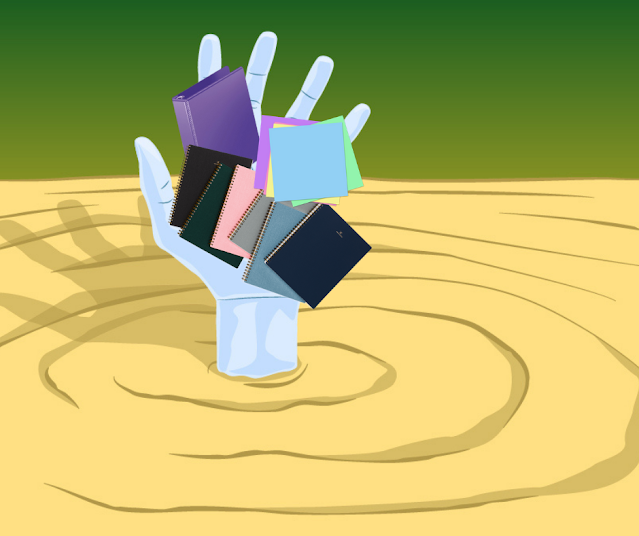
The Quicksand Mire of Book Project Supplies...


The objects are plenty.
Sticky notes, binders, story boards, loose-leaf paper, notebooks, the backs of cocktail napkins, toilet paper, your sandwich wrapper...
 
All colorful, multi-textured.
All meaningful, purposeful.
All exciting, thrilling to collect and to organize and to display.
 
Most all... a COMPLETE WASTE OF MONEY AND TIME.
 
Gotcha!
You thought for once I'd be on the newbie writer side.
Ha! Fooled ya!
You seriously do not know me and my skill at offending all 'n' sundry.
 
I have witnessed multitudes of new writers gather and show and talk about the plethora of stationery supplies they've commercially coveted and slobbered over in their "supposed" crafting of that Great American novel...that NEVER GETS FINISHED.
 
Crikey, if I had a nickel for every sticky note and chapter tab bought and used that amounted to nothing in the way of a completed book, the super yacht I'd be building would be bigger than Bezos'!
 
And let's not even go down the road as to the time wasted playing with these desk top toys... 
 
*enter elevator muzak while I hang myself from sheer despondency*
 
Your conjured tale doesn't take an ark's worth of office gadgets to facilitate words down on a screen or on paper. Seriously, peeps. I know you think differently, but you're fooling yourself.
 
You've decided that it's "working on your novel" if you're out buying those supplies, organizing binders and color-coding story boards and filling the edges of your monitor with sticky notes. 
 
If friends or family ask, "Have you started writing that book?"
You think by fiddling with this stuff you can honestly say, "Yes, well, yes, I have! Aren't I The Special One!"
 
Oh, you're "special" alright... to the manager of your neighborhood Staples store as he counts that day's takings...$$$
What was your receipt total again? $56.99
Well, good for you! You're a Charlie Sheen winner!
 
"How many paragraphs did you write on said book today?" I ask.
"Uh, none, cuz, well, by the time I got home from Staples...and then the dog was hungry, and after dinner with the family, it took me time to unpack the bags..."
 
*enter elevator muzak while I get a stronger rope with which to hang myself again, and this time for realzies*
 
Peeps, stop screwing around.
 
I get it.
I know you're scared shitless.
You think you're a fraud, a fake.
Who are YOU to think a book is possible?
Your attempt at writing a book is laughable... once you get up from your crying jag in that fetal position in the corner of your bedroom...
But you want to write a book, gosh darn it! And besides, you've told EVERYBODY you're going to.
 
Stop. Just stop with the silliness. Dry your eyes. Here's a tissue.
*hands silly newbie book writer a tissue*
 
You CAN write that book.
You know how?
By grabbing any level medium and any old writing tool and scribbling down words, one right after the other, until you write, The End.
 
No muse.
No rocket science.
No taking out a second mortgage to afford to buy all that crap at Staples.
 
Pick one thing, one simple thing, to house your scene details.
Put those things in order.
Flip each as you write out each scene.
Donesco.
 
I don't care what you pick - notebook paper, recipe cards, birchbark strips, toilet paper squares - just pick ONE, write 1-2 lines on each describing each scene, put them in a pile, and start flipping.
 
Geez, if writing books were rocket science I'd be banned from writing books. There's a reason why the Irish are good with words and don't build bridges... Sorry, *ahem*, got on a tangent tear there...
 
A Real World Example:
My recent manuscript, AIR, came in at around the epic literary length of 115,000. That's after line edits - two - and a ROL - Read Out Loud - edit, and after my naval expert beta.
The entire book was crafted from...*drum roll*...
Plain old recipe cards like the ones your mom used to write down her mother-in-law's Sunday dinner recipes that she wouldn't make in a month of Sundays because her mother-in-law was a lousy cook.
You know, THOSE recipe cards. 
 
 
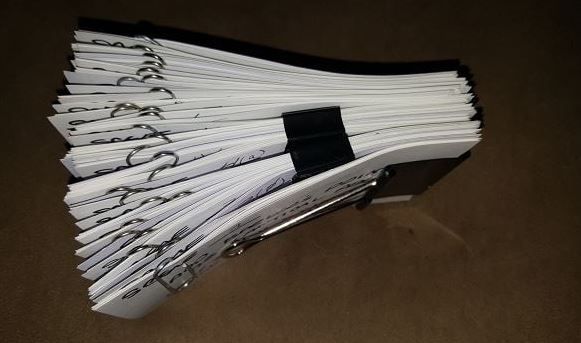
The photo above, showing all my scene cards for AIR, is the entire book in a 4x6 rectangle nutshell. Below, I'll explain the paper clips you see there as well.
 
You can buy recipe cards for super cheap in a dollar store or go whole-hog-highfalutin with the executive kind at Staples if you're still jonesin' to spend dough. It's a free country.
 
I advise buying the BLANK ones, so your creative mind won't be stymied by the lines. Blank ones can also facilitate small diagrams drawn or what have you that might come in handy for scene cues.
 
1-2 summary sentences explaining what this scene is about - its plot purpose/character motivation and/or evolution/devolution.
NOT chapter cards, scene cards. Don't think rationally, think creatively.
Worry later which scenes get lumped into which chapters.
 
Paper Clips: I've attached cards BEHIND each scene card - I call Factoid cards - that hold extraneous information - scientific and/or historic facts/data, quotes/poems/lyrics to be used, dialogue lines - basically any outstanding info I'll need to complete that scene. You can color code those factoid cards to denote certain subject matter if you choose - exs. green for quotes, blue for science/data, brown for historical data etc. Also, you can put emergency add-ins cards at the front of the pile, maybe written in red, of details you forgot to write into the first draft. 
 
Note: color coding is NOT a must. Only do if it makes you find what you're looking for quicker. This step is not for fun, peeps.
 
Fill out these cards with all the scenes from start to finish, as you know them now.
They can be changed, deleted, altered in their line-up at ANY time.
They can be carted with you in your pocket, a couple at a time, to an outside venue, when you do NOT want to plug into a device. (Yes, Scrivener has the same virtual deal, but those cards aren't real. You need to be on your computer to access those. Why limit yourself? And why pay for Scrivener when any word processing blank page will do?)
 
With my first novel, my mother was ill and in the hospital where Wi-Fi wasn't available. I wrote most of that novel from those cards, on paper in endless waiting rooms.
 
Note: You do NOT have to adopt my method.
I'm just saying choose ONE, one SIMPLE and EASY to use medium that is CHEAP on money and stingy on your time.
 
What counts isn't your project supply chain. It's those words down on paper. However they get there, they get there. Don't reinvent the wheel to get there, and waste scads of time and money in the process.
 
Now, be off with you!
Scene on!

11 May

The Story Start and The End...


The Start and the End...
You need to know where you're going in order to get there.
 
This may sound like a DUH! fact, but new writers often forget this, or worse, ignore this fact outright.
 
Yesss... you can start out on a forest trek, having zero idea where you're going, but the odds of you getting lost and eating your hiking boot leather for nourishment is fairly high.
 
So it goes with ANY endeavor.
 
Why new writers think story-telling is exempt from this life-saving practice is beyond me. They conjure up a flowing neck scarf, chiffon curtains, and an unseen ocean breeze that births their muse, and off they go to tale creation perfection land, plunking down one mindless word after another... 
 
There are no words to match my rolling eyes and look of disdain...
 
Yesss... by sheer luck, those words may draft out a hint of a story just like a lottery ticket may make you a millionaire. But odds are I'll be finishing my umpteenth book while said Pantser - one who writes by the seat of their pants, with no idea where they're going - will endlessly toil over editing rewrites until their fingers bleed.
 
I've painfully, sadly, witnessed this first hand.
There was a woman I met at a writer's conference in 2013 who refused to even entertain the need for a story path, and to date, I'm editing my fourth literary novel, and she's still rewriting that tale, the constant rewrites long ago killing whatever passion there may have been in the original words and idea. 
 
So, yes, you can subscribe to the breezy notion of Pantserdom, but from where I'm sitting that's a hot seat in the despondent depths of Hell.
 
I'm NOT forcing you to know every nook and cranny of your story. 
What I'm saying is you need to know from the start where the tale starts and where it ends. 
What you see first and what you see last. 
That's so your path is straight and true along that journey.
 
You're guiding readers, remember? 
Do you want them to eat their hiking boot leather for nourishment, too?
 
If you begin to outline the scenes you see, right now, even in vague, 1-2 sentence terms, each on their own scene card, then as you move forward in the tale, you will write along a productive path.
 
In my youth, I used to be a long distance swimmer. I would know where I first dove in, and I would know my end point. And along the way, I had a coach in a boat alongside me to ensure I didn't stray too far away from the route, so I would reach the end point in the most efficient manner. If I hadn't had a guide, I could have easily strayed off course and become too exhausted to finish the competition, never mind placing first. 
 
Don't assume writing a book is anything different.
 
If you have wild, romantic notions of this métier, drop them.
They don't exist in reality.
 
Write down the first scene you see.
Write down the last scene you see.
Write down any scenes which come to your mind that get you along that path, from Start to Finish.
 
Remember: No scene card is written in stone.
They can always be changed or altered in their line-up. 
 
What this rough fleshing out does for you is two things:
a) it gets your mind focusing on a single tale, so it can work on it in the conscious and the subconscious,
b) it provides your mind with a guided story path to follow to book completion. 
 
The odds of you,
~ wildly going off course
~ writing yourself into a plot corner
~ creating plot/character black holes
is IMMENSE without a rough story guide.
 
In my current literary novel, AIR, I saw an image of the capsized USS Oklahoma battleship, and the moment I saw it, a disembodied voice said to me, "We're in here. Get us out." Then, sometime later - it may have been a few days - I saw the end scene. I knew where this tale was going.
 
As the weeks drew on, and I began to research the history of the Oklahoma's part in the Pearl Harbor attack, all six primary characters began to take shape in my mind and subsequent scenes birthed that would get me from scene A to scene Z, and I jotted each down in 1-2 sentences on a recipe card.
 
Over the next months, those cards increased, and my knowledge of the history/facts got to the point where I was ready to begin writing. And from that moment on, all it took was to flip those scene cards, one by one, and draft those scenes into a full narrative.
 
Writing a book is not rocket science, but it does have a process, and the sooner you realize this the better your book writing success will be.
 
It doesn't matter in what genre you write or what unreal worlds exist therein. If it's a book humans will read, it must have a reasoned progression. That is not to say there won't be surprises along the way, for the author, first, and of course, for the reader, but you need a path to follow so no such plot/character block or black hole will materialize - mechanical or psychological - in completing your book.
 
Before you put up your hand in protest, seriously consider what I've just said. I'm spouting a truism which has led to completing four research-heavy historical literary novels, one child's adventure story memoir, and a writer's How To.
 
Do you want to complete your book with a minimum of frustration and edit rewrites?
Or does the romantic notion of writing like a Pantser supersede your desire to competently finish your book?
 
Reality or Fantasy, peeps?
Unfinished manuscript? Published book?
It's up to you.

27 March

Why Does It Feel So Hard To Start Writing?


A new writer messaged me, "But why does it feel so hard to start?" in referencing beginning one's first book. I wrote to this person, thus:
 
It's difficult because in your own mind you've not yet cemented your message - what you want to convey in this book. 
 
Writing a book is NOT about sitting down at a pad of paper or a keyboard and typing words. It's about conveying an idea to the reader. You will never be able to do that until you KNOW that idea for yourself. 
 
"Pantsers" who type, unaware of what they're typing, can tell a vague story, BUT that story will have umpteen edits post initial draft. 
 
They will go off course.
They will write themselves into plot corners.
They will have numerous inconsistencies exs. character details/depth, motivation.
Tension will be lacking or off. Etc., etc., etc.
And often, in the end, they will become frustrated with all the manuscript errors and simply give up, the MS never becoming a finished book.
 
If you want a finished book with very few edits post initial draft, you need to follow certain steps. That's a fact.
 
Filling out scene cards will help you in this challenge.
 
HOMEWORK: Start filling out scene cards — each blank recipe card describing in a few sentences the essence/goal of the scene, and complete the Log Line — a single sentence boiling down the essence of your book. Until you can complete your Log Line and recite it off the cuff, naturally, to anyone who asks, you do not know the essence of your book; hence, you will not be able to write what you do not know.
 
I invite ALL of you here to do the homework, if you've not yet crafted your book outline or know your Log Line. 
 
Trust me on this process. 
You do the steps, and you WILL complete your book, but you have to do the work. 
 
Writing a book is NOT a romantic notion. It's work. Do the work, and your book will get written. Sit down, all giddy with excitement, with a scarf wrapped around your neck, blowing in the breeze - and a vacant mind on top of that neck - and you will not finish your book.
 
One step at a time. Follow my steps. 
Let's get your book written!

26 March

Book Outlines - Scene Cards an Option...


How many of you have made up an outline for your book? If you have,
 
Have you considered writing scene cards over any other method? 
 
Scene cards can be switched around far easier than chapters written on a piece of paper, and your mind's eye will better view your tale in a single moment in time, holistically, over mere linear or numerical.
 
I will talk in a later post how to use scene cards, but for now...
 
Tell us what issues have've had in storyboard creation? Comment below.